
- Invasive SCC has grown deeper than the epidermis into the dermis.
- Usually a firm red bump or crusty scaly nodule on sun-exposed skin.
- Standard surgical excision is first-line — cure rate around 95% or more.
- Routine scans and lymph node biopsy not needed in most cases.
- Higher-risk SCCs (larger, deeper, perineural invasion, immunosuppressed) need closer follow-up.
- Recurrence usually within 2–3 years if it happens — hence the importance of follow-up.
Squamous cell carcinoma (SCC) is the second most common type of skin cancer (after BCC). It is divided into two categories based on how deep it goes: in situ (only in the top layer) and invasive (growing into deeper layers). This page covers invasive SCC. These skin cancers are very treatable and are usually nothing like melanoma in terms of danger as long as treated properly.
What Is Invasive SCC?
Invasive SCC means the cancer cells have grown deeper into the skin beyond the epidermis. This is what doctors often simply call “squamous cell carcinoma.” It is no longer confined to the top layer.
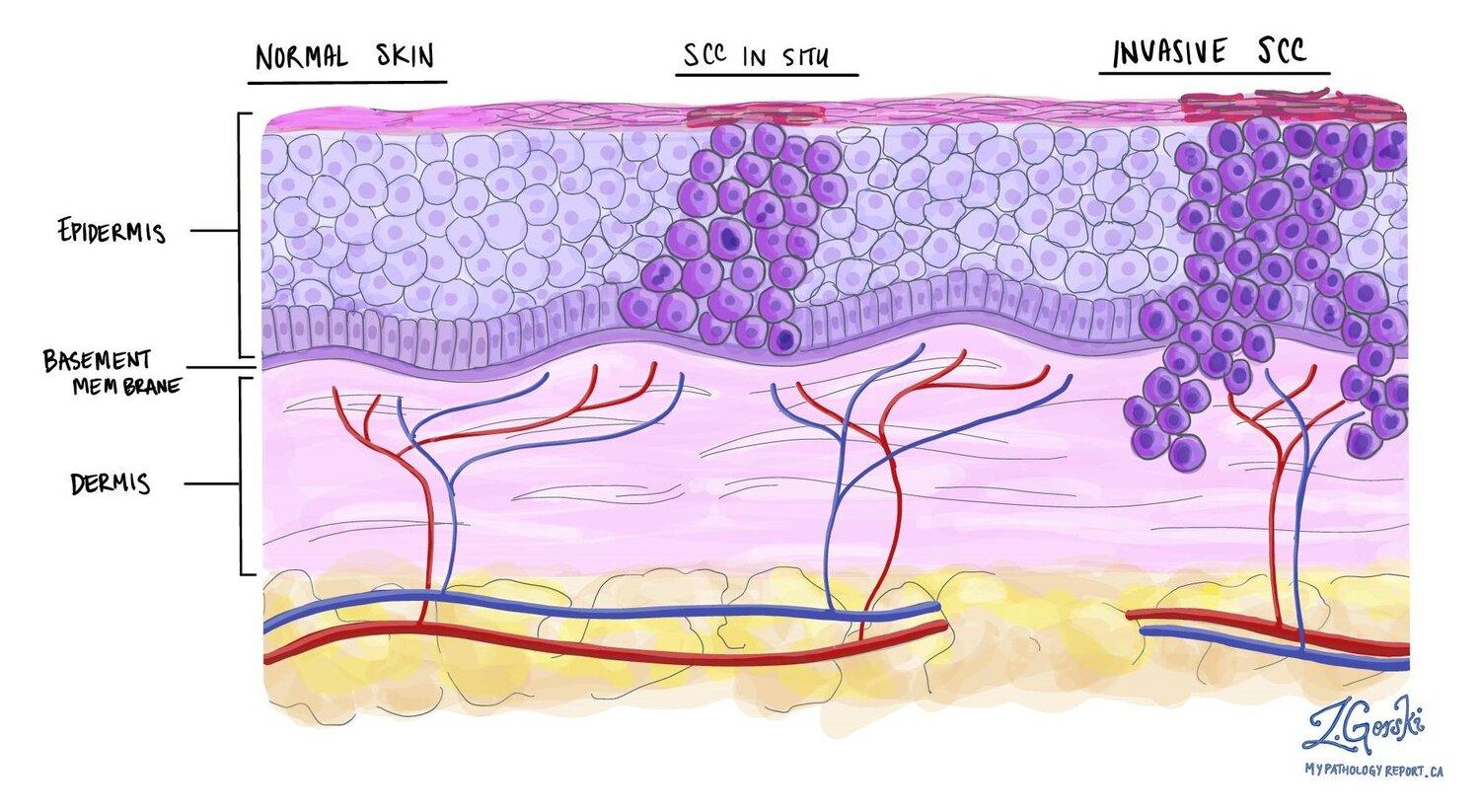
Invasive SCC usually appears as a firm red or skin-coloured bump or a crusty, scaly nodule. It might ulcerate (get a sore in the middle) or bleed, especially if bumped. Common locations are sun-exposed areas like the face (especially lips), ears, bald scalp, neck, arms, and hands. These tumours can also arise in old scars or chronic wounds.
Invasive SCC can grow outward and inward, and if neglected it can become a fairly large sore. The good news is that most SCCs are found when they are still fairly small (often less than 2 cm) and have not spread anywhere else. When found early it is highly curable and unlikely to spread.
How Is It Treated?
The main treatment is to remove the tumour. Because it has grown into the skin, a slightly more robust treatment than for in situ is needed.
Surgical excision
This is the most common treatment. The surgeon injects a local anaesthetic (to numb the area) and then cuts out the SCC along with a small margin of normal skin around it. The wound is then closed with stitches. The removed tissue is sent to a lab to ensure the edges are clear of cancer cells.
Excision is usually an outpatient procedure that takes only a short time. It has a very high cure rate (around 95% or more for a first-time SCC) when margins are clear.
Curettage and Electrodessication
For very small, thin SCCs (or certain low-risk sites), the doctor may scrape the tumour out with a curette and burn the base. However, this is more often used for BCC or pre-cancers — invasive SCC is usually better removed via standard surgery to be sure it is gone.
Radiation therapy
If surgery is not an option (for example, a patient who cannot have surgery or a site that is hard to operate on), targeted radiation can be used to destroy the tumour. Radiation might also be added after surgery in rare cases where an SCC had some spread or could not be entirely removed. Most patients with SCC do not need radiation — it is reserved for special situations.
Other therapies for advanced cases
In the rare event that an SCC has spread to other body parts or cannot be removed surgically, there are newer treatments like immunotherapy (medicines that help your immune system kill the cancer) or chemotherapy. These treatments are only needed for a very small minority of SCC patients. The vast majority of invasive SCCs are cured with local treatment (surgery or similar) and never require these additional therapies.
Why No Extensive Scans or Tests in Most Cases?
Unlike many internal cancers, a routine invasive SCC doesn’t require CT scans, PET scans, or a bunch of blood tests.
This is because in most cases (especially small, early SCCs), the chance that it has spread beyond the skin is extremely low. The doctor will do a thorough skin exam and feel the nearby lymph nodes during your exam — that is typically sufficient. If the SCC is caught early and removed completely, that is usually the end of the story (apart from follow-up skin checks). There is no need to put you through unnecessary scans that are unlikely to show anything.
Prognosis and Follow-Up
The cure rate for invasive SCC is very high, especially when caught early. A small SCC removed with proper margins has a cure rate around 95% or higher.
In cases where an SCC does come back or spread, it usually happens within the first 2–3 years, which is why your doctor will schedule follow-up skin exams.
Importantly, even though invasive SCC can be more serious than BCC, in most typical situations it is still very manageable and unlikely to ever be life-threatening. We emphasise sun protection and regular check-ups because people who have had one SCC might develop another new one in the future (sun-damaged skin can pop out multiple cancers over time). But with vigilance, these can be caught early and treated easily as well.
Symptoms
- Firm red or skin-coloured bump
- Crusty, scaly nodule
- May ulcerate (a sore in the middle)
- May bleed, especially if bumped
- On sun-exposed skin such as the face, lips, ears, scalp, neck, arms and hands
- Can grow outward and inward into a larger sore
Frequently asked questions
-
Is invasive SCC dangerous?
Invasive SCC means the cancer has grown deeper than the top layer of skin, but in most typical situations it is still very manageable and unlikely to ever be life-threatening. Most SCCs are found while still fairly small and have not spread anywhere else, and when caught early it is highly curable and unlikely to spread. It is usually nothing like melanoma in terms of danger, as long as it is treated properly. -
How is invasive SCC treated?
The main treatment is to remove the tumour, and surgical excision is the most common approach. The doctor numbs the area with local anaesthetic, cuts out the SCC along with a small margin of normal skin, and closes the wound with stitches. The removed tissue is sent to a lab to make sure the edges are clear of cancer cells. -
What are the chances invasive SCC is cured?
The cure rate for invasive SCC is very high, especially when caught early. A small SCC removed with proper margins has a cure rate of around 95% or higher. The vast majority of invasive SCCs are cured with a simple outpatient procedure and never need any further therapy. -
Will I need scans or blood tests for my SCC?
In most cases, no. Unlike many internal cancers, a routine invasive SCC doesn't require CT scans, PET scans or a batch of blood tests, because the chance it has spread beyond the skin is extremely low for small, early tumours. Your doctor will do a thorough skin exam and feel the nearby lymph nodes, which is typically sufficient. -
Does invasive SCC need radiation or chemotherapy?
Most patients with SCC do not need radiation — it is reserved for special situations, such as when surgery is not an option or in rare cases where some spread has occurred. Newer treatments like immunotherapy or chemotherapy are only needed for a very small minority of patients. The vast majority of invasive SCCs are cured with local treatment alone. -
Can invasive SCC come back after treatment?
It can, though for most people removal is the end of the story apart from follow-up. In the cases where an SCC does come back or spread, it usually happens within the first 2–3 years, which is why your doctor will schedule follow-up skin exams. People who have had one SCC may also develop a new one in future, since sun-damaged skin can produce multiple cancers over time. -
Why do I still need regular skin checks after my SCC is removed?
Because sun-damaged skin can produce more than one cancer over time, people who have had one SCC might develop another new one in the future. Follow-up exams also catch any recurrence early, since these usually appear within the first 2–3 years. With this kind of vigilance, new lesions can be caught early and treated easily.
References
- Clinical practice guidelines for keratinocyte cancer. Cancer Council Australia. (NHMRC-approved 2019.)
- Guidelines of care for the management of cutaneous squamous cell carcinoma. J Am Acad Dermatol. 2018. (American Academy of Dermatology.)DOI: 10.1016/j.jaad.2017.10.007
- Cutaneous squamous cell carcinoma — an updated review. Cancers (Basel). 2024.DOI: 10.3390/cancers16101800
Related
Related conditions
Medically reviewed by Dr Christopher Irwin, MBChB, FRACGP, MMed (Skin Cancer), FACAM, MSCCA · Last reviewed 2026-06-06 · Editorial policy