
- Treats actinic cheilitis (solar cheilitis) — the lip equivalent of an actinic keratosis, usually on the lower lip.
- Uses an Er:YAG erbium laser to ablate biopsy-confirmed atypical cells layer by layer, preserving the deeper structure and muscle of the lip.
- Unlike surgical vermilionectomy, the treated surface regenerates rather than being cut away and reconstructed with advancing oral mucosa.
- A systematic review of 20 studies and 512 patients reported complete clearance in about 92.5% of laser-treated patients.
- May be combined with photodynamic therapy to treat the surrounding field of subclinical sun damage.
- Er:YAG laser-assisted PDT achieved 92% clearance versus 59% for PDT alone in a randomised actinic cheilitis trial, with 12-month recurrence of 8% versus 50%.
- Biopsy comes first — the laser destroys the tissue it treats, so nothing is left to send for pathology.
- Not a substitute for surgery when invasive squamous cell carcinoma is suspected or confirmed.
- SCC on the vermilion lip metastasises to lymph nodes about five times more often than SCC on the adjacent cutaneous lip (7.6% vs 1.5%).
- A Medicare rebate may apply under MBS item 45669 when there is biopsy-confirmed cellular atypia and the entire lip is treated.
Laser vermilionectomy — sometimes shortened to laser vermillectomy — is a treatment for extensive sun damage and precancerous cellular change affecting the vermilion, the red surface of the lip.
At The Skin Doctor, Dr Christopher Irwin uses a medical Er:YAG erbium laser to remove the abnormal surface of the vermilion by controlled, layer-by-layer ablation. In selected patients this is followed by photodynamic therapy to treat remaining abnormal cells and the surrounding field of sun damage. A Medicare rebate may apply when the treatment meets the requirements of MBS item 45669. 6
Treatment is available at our Ivanhoe and Diamond Creek clinics in Melbourne’s north-east.
What is actinic cheilitis?
Actinic cheilitis is chronic ultraviolet damage affecting the vermilion of the lip. It is essentially the lip equivalent of an actinic keratosis or sunspot. 7
It most often affects the lower lip, which receives more direct ultraviolet exposure and has thinner, less pigmented tissue than normal skin.
Possible signs include:
- Persistent dryness, scaling or roughness.
- Cracking or recurrent crusting.
- White, pale, red or mottled areas.
- Blurring of the normally sharp border between the lip and the surrounding skin.
- A persistently tender area.
- An ulcer or sore that does not heal.
- Thickening, or a developing lump.
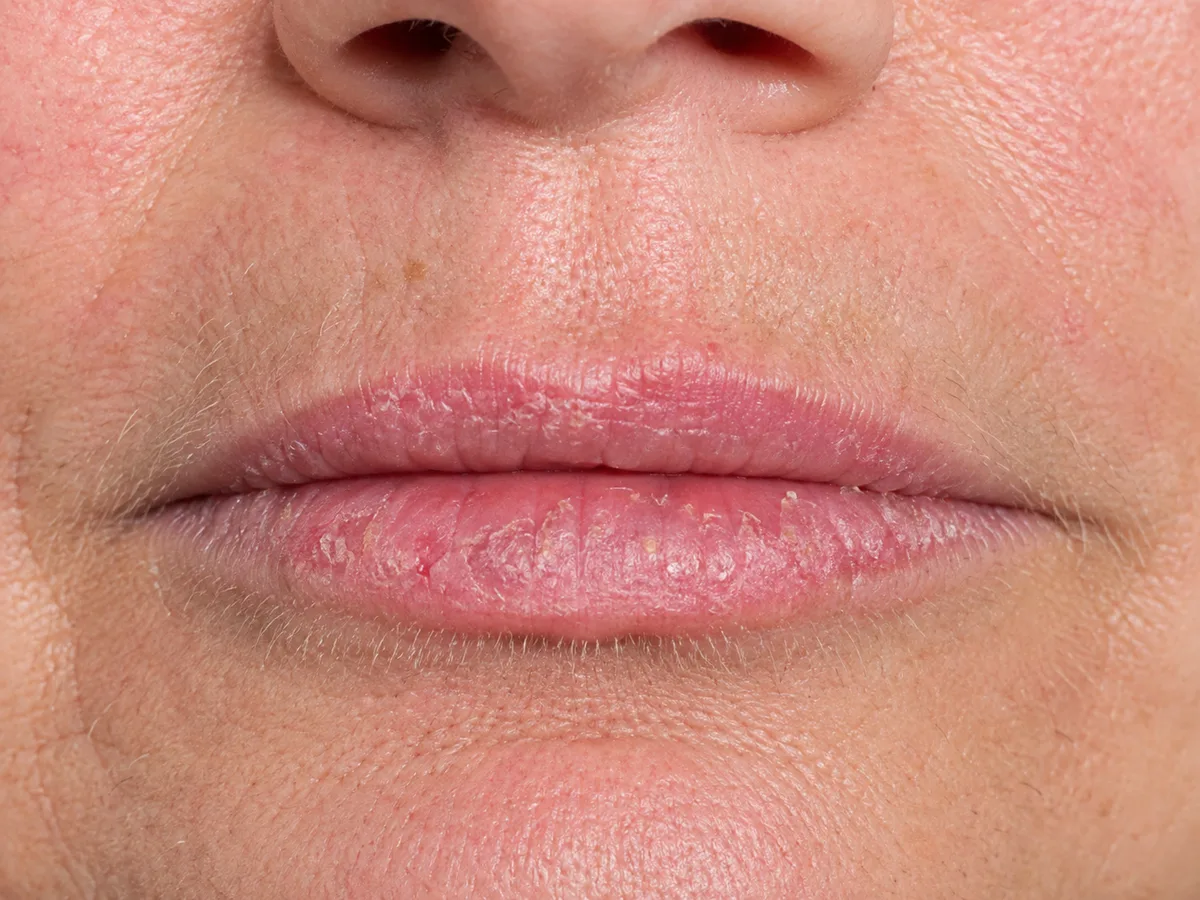
Actinic cheilitis is considered precancerous because abnormal cells can progress to squamous cell carcinoma in situ or invasive squamous cell carcinoma. A persistent ulcer, an enlarging nodule, focal tenderness or a thickened area needs particular attention and may need to be biopsied.
Is actinic cheilitis cancer?
Not necessarily. Actinic cheilitis represents a spectrum of sun damage ranging from mild cellular atypia through to severe dysplasia or squamous cell carcinoma in situ.
The appearance of the lip does not reliably reveal how abnormal the cells are. A relatively subtle patch can contain significant dysplasia, while a visibly damaged lip may contain areas of quite different histological severity.
For this reason, suspicious or clinically significant areas are normally biopsied before ablative treatment. If invasive SCC is identified, a treatment offering complete margin control — surgical excision or Mohs surgery — may be more appropriate than laser ablation.
Why the lip matters
Why is squamous cell carcinoma of the lip more serious?
Most cutaneous squamous cell carcinomas are highly treatable when found early. SCC involving the vermilion lip, however, spreads to regional lymph nodes considerably more often than SCC on many other skin sites.
A JAMA Dermatology cohort study examined 310 squamous cell carcinomas of the lip (172 vermilion, 138 cutaneous). Nodal metastasis occurred in: 1
- 7.6% of cancers on the vermilion lip, compared with
- 1.5% of cancers on the adjacent cutaneous lip.
On multivariable analysis this was approximately a fivefold increase in the risk of nodal metastasis when the cancer involved the vermilion (subhazard ratio 5.0; 95% CI 1.1–23.8). 1
This does not mean every case of actinic cheilitis will become cancer. It does mean persistent precancerous lip change deserves proper diagnosis, appropriate treatment and ongoing surveillance rather than being dismissed as ordinary dry or chapped lips.
What is laser vermilionectomy?
Laser vermilionectomy is an ablative procedure that removes the sun-damaged and atypical surface cells of the vermilion while preserving the deeper structures of the lip.
Dr Chris uses an Er:YAG erbium laser, whose wavelength is strongly absorbed by water within the tissue. This allows abnormal epithelium to be removed in extremely controlled layers with limited thermal spread into the surrounding lip.
Unlike a traditional surgical vermilionectomy, laser treatment does not usually require the diseased surface to be cut away and the lip reconstructed with advancing oral mucosa. The treated surface is instead allowed to regenerate and re-epithelialise as it heals.
Laser therapy is among the most effective procedural treatments studied for actinic cheilitis. A systematic review covering 20 studies and 512 patients reported complete clearance in approximately 92.5% of laser-treated patients, with a maximum reported recurrence rate of 21.43% — though technique, follow-up duration and recurrence reporting varied considerably between studies. 2 A 2025 systematic review and meta-analysis likewise found high clearance across ablative laser treatments, while emphasising that results and adverse effects vary with the laser used, the technique and individual patient factors. 3
Who may benefit from laser vermilionectomy?
Laser vermilionectomy may be considered for patients with:
- Biopsy-confirmed actinic cheilitis with cellular atypia or dysplasia.
- Widespread sun damage involving much of the lower lip.
- Recurrent disease after cryotherapy, topical treatment or previous procedures.
- Thick, persistent or treatment-resistant actinic cheilitis.
- Significant field change extending beyond one isolated visible lesion.
- Difficulty completing several weeks of inflammatory field treatment with Efudix (5-fluorouracil) or Aldara (imiquimod).
- A preference for a single in-clinic procedure, after discussing the benefits, healing period and alternatives.
Suitability depends on examination, biopsy findings, the extent of disease, previous treatments, general health and your ability to manage the wound care.
When is laser treatment not appropriate?
Laser ablation is generally not the preferred treatment when there is an untreated or inadequately sampled area suspicious for invasive SCC.
Warning features include:
- A persistent or deep ulcer.
- A growing lump or nodule.
- Marked focal thickening or firmness.
- Unexplained bleeding.
- Persistent localised pain or tenderness.
- Numbness or altered sensation.
- Enlarged lymph nodes beneath the jaw or in the neck.
- Rapid recurrence after previous treatment.
These findings may require further biopsy, imaging, surgical excision or specialist multidisciplinary care.
An active cold sore or bacterial infection must also be settled before treatment. Patients with a history of herpes simplex may be prescribed preventive antiviral medication around the procedure.
The procedure
What happens during laser vermilionectomy?
1. Assessment and diagnosis
Dr Chris examines the lip, including the full vermilion border and the surrounding skin.
Any area that is unusually thick, ulcerated, tender or otherwise suspicious is biopsied before treatment. This matters because the laser destroys the treated tissue, meaning it cannot afterwards be submitted for histopathological examination.
The biopsy helps determine whether the changes represent:
- Actinic cheilitis with atypia.
- Squamous cell carcinoma in situ.
- Invasive SCC.
- Another inflammatory, infectious or dermatological condition.
2. Treatment planning
The extent and depth of treatment are planned from the clinical examination and the biopsy findings. You will receive instructions covering antiviral prophylaxis where appropriate, medications that may increase bleeding, eating and drinking before treatment, transport home if sedating medication is planned, and the lip-care supplies you will need during recovery.
3. Local anaesthetic
The lip is thoroughly anaesthetised, usually with local anaesthetic injections or regional nerve blocks. You may feel the injections, pressure or movement, but the ablative part of the procedure should not feel sharp or painful once the anaesthetic is working.
4. Er:YAG erbium laser ablation
The erbium laser is passed over the affected vermilion in controlled layers. The aim is to remove the damaged epithelium and biopsy-confirmed atypical cells while preserving healthy deeper tissue and the functional structure of the lip. Depth and the number of passes are adjusted to the clinical and histological severity of the disease.
5. Dressing and wound care
The treated area resembles a superficial graze or burn immediately after the procedure. An ointment or dressing is applied to protect the exposed surface. You will receive detailed instructions on cleaning, ointment application, pain relief, eating, drinking, and the signs of infection.
6. Review
The lip is reviewed after healing to assess the clinical response. Any persistent focal abnormality may need a repeat biopsy rather than simply repeating the laser treatment.
Long-term surveillance remains important, because treatment removes current disease but does not reverse the lifetime of ultraviolet exposure that caused it. Ongoing skin checks should continue according to your individual risk.
Combined treatment
Why might photodynamic therapy be added?
Actinic cheilitis is often a field disease — abnormal cells may extend well beyond the thickest or most visibly damaged areas of the lip.
Laser treatment physically removes the abnormal surface. In selected cases, Dr Chris may then recommend photodynamic therapy (PDT) to extend treatment across the remaining microscopic and subclinical field change.
PDT involves:
- Applying a photosensitising medication such as aminolevulinic acid or methyl aminolevulinate (MAL).
- Allowing abnormal cells to preferentially accumulate the light-sensitive compound.
- Activating it with medical-grade red light.
- Producing reactive oxygen molecules that damage the targeted precancerous cells.
Laser preparation also improves penetration of the photosensitiser into abnormal tissue.
Randomised evidence in actinic cheilitis supports the combination. In a prospective randomised comparative trial, a single session of Er:YAG ablative fractional laser-assisted MAL-PDT achieved a 92% complete response at three months, compared with 59% for two sessions of conventional MAL-PDT alone. At 12 months, recurrence was 8% in the laser-assisted group versus 50% for PDT alone. 4 A 2025 meta-analysis similarly found a significantly lower recurrence rate for Er:YAG laser-primed MAL-PDT than for MAL-PDT alone (odds ratio 0.22; 95% CI 0.06–0.82). 3
This does not mean every patient requires PDT, nor that combined treatment has been proven superior to a complete laser vermilionectomy in every situation. It is an additional field-treatment strategy, selected according to the extent of disease, biopsy findings and previous treatment response.
Recovery after laser vermilionectomy
The lip is highly vascular and sensitive, so swelling can be prominent during the first few days.
| When | What to expect |
|---|---|
| First 24–72 hours | Swollen, red, tender, moist or weeping. Sensitive when eating, drinking or speaking. Small amounts of spotting or blood-stained fluid can occur. |
| Days 4–10 | A protective surface forms and the wound gradually re-epithelialises. Crusting or peeling occurs. Regular ointment and gentle wound care matter; picking at crusts delays healing and raises the risk of infection and scarring. |
| 1–2 weeks | Most patients have developed a new surface over the treated area, although the lip may stay pink, tight and sensitive. |
| 2–4 weeks and beyond | Residual redness, dryness and sensitivity continue to improve. Some patients take several weeks before the lip feels completely normal. |
Published erbium laser series describe healing continuing for up to about four weeks, and recovery varies with treatment depth, the area treated, smoking, general health and individual wound healing. 2 Dr Chris will give you a personalised recovery estimate once the required treatment depth and extent are known.
Risks and possible side effects
Laser vermilionectomy deliberately creates a controlled wound. Expected effects include pain, swelling, weeping, crusting and temporary difficulty eating certain foods.
Less common or potentially significant risks include:
- Bleeding.
- Bacterial infection.
- Reactivation of herpes simplex (cold sores).
- Delayed wound healing.
- Persistent redness or sensitivity.
- Temporary or, rarely, persistent altered sensation.
- Changes in pigmentation.
- Textural change, or an altered vermilion border.
- Hypertrophic or otherwise noticeable scarring.
- Asymmetry or contraction of the treated lip.
- Incomplete clearance.
- Recurrence of actinic cheilitis.
- A need for further biopsy, laser treatment, PDT or surgery.
- Failure to identify an invasive SCC, if suspicious areas were not adequately biopsied before ablation.
Smoking, immunosuppression, poor circulation and continued ultraviolet exposure may impair healing or increase the risk of recurrence.
Cost
Medicare rebate for laser vermilionectomy
A Medicare rebate may be available under MBS item 45669. The current MBS descriptor is: 6
Vermilionectomy for biopsy-confirmed cellular atypia, using carbon dioxide laser or erbium laser excision – ablation.
The associated explanatory note (TN.8.106) states that item 45669 covers treatment of the entire lip. 6
Medicare eligibility therefore generally requires:
- Histological confirmation of cellular atypia from a biopsy.
- Treatment using a qualifying carbon dioxide or erbium laser.
- Treatment of the entire lip, as required by the explanatory note.
- Satisfaction of the remaining Medicare and clinical requirements.
A Medicare rebate does not necessarily cover the full treatment cost, and an out-of-pocket gap may remain. Consultation, biopsy, histopathology, PDT, medication and follow-up care may attract separate fees. We will confirm likely Medicare eligibility and provide an itemised treatment estimate before proceeding — see our skin cancer services and fees page for how our pricing is structured.
Alternatives to laser vermilionectomy
The best treatment depends on the extent and severity of the disease. 5
| Option | Where it fits |
|---|---|
| Close surveillance | Selected mild changes, with strict lip sun protection. |
| Cryotherapy | Small, isolated areas rather than widespread field change. |
| Efudix (5-fluorouracil) | Topical field treatment applied at home over several weeks; produces a prolonged inflammatory reaction. |
| Aldara (imiquimod) | Topical immune-activating field treatment in selected cases. |
| Photodynamic therapy | Field treatment without full laser ablation, or combined with it. |
| Traditional surgical vermilionectomy | Excision of the diseased vermilion with reconstruction using advancing oral mucosa. |
| Surgical excision or Mohs surgery | Where invasive SCC is present or suspected and margin control is required. |
Vermilionectomy and ablative laser treatment generally achieve more favourable clearance and recurrence outcomes than many topical or less intensive treatments, although they require a more significant initial healing period. 2,5
For the full range of field treatments for sun-damaged skin, see actinic keratosis treatment options.
Preventing further sun damage
Treatment removes existing abnormal cells but does not remove the underlying tendency to develop further ultraviolet damage. After healing, ongoing prevention should include:
- Regular use of a high-SPF broad-spectrum lip balm.
- Reapplication after eating, drinking or wiping the lips.
- A broad-brimmed hat.
- Avoiding prolonged outdoor exposure when the UV index is high.
- Smoking cessation.
- Regular self-examination of the lip and surrounding skin.
- Routine skin cancer checks according to your individual risk.
Any new ulcer, lump, thickened area, bleeding point or persistent tenderness should be assessed promptly.
Book an assessment with Dr Chris
Persistent scaling, crusting, thickening or ulceration of the lip should not be assumed to be ordinary dryness — particularly when it affects the lower lip and does not heal.
Book a focused 20-minute short skin review with Dr Christopher Irwin to:
- Confirm whether the changes are consistent with actinic cheilitis.
- Identify any area that requires biopsy.
- Review existing histopathology.
- Discuss laser vermilionectomy and photodynamic therapy.
- Determine whether a Medicare rebate may apply.
- Compare laser treatment with topical and surgical alternatives.
Appointments are available at The Skin Doctor in Ivanhoe and Diamond Creek.
Alternatively, call (03) 8373 4646.
Related pages
- Actinic Keratosis (Sunspots)
- Actinic Keratosis Treatment Options
- Laser-Assisted PDT for Actinic Keratosis
- Laser-Assisted PDT for Non-Melanoma Skin Cancer
- Squamous Cell Carcinoma
- SCC in Situ (Bowen’s Disease)
- Efudix (5-fluorouracil)
- Non-Surgical Treatment of Non-Melanoma Skin Cancer
This information is general and does not replace an examination, histopathological diagnosis or personalised medical advice. Treatment recommendations depend on the extent and depth of disease, biopsy findings and individual health factors.
What to expect
-
Assessment and diagnosis
Examination of the full vermilion, the vermilion border and the surrounding skin. Any area that is thickened, ulcerated, tender or otherwise suspicious is biopsied before treatment — the laser destroys the tissue it treats, so it cannot later be sent for histopathology.
-
Treatment planning
Extent and depth of ablation are planned from the clinical findings and the biopsy report. You receive instructions on antiviral prophylaxis where appropriate, medications that may increase bleeding, eating and drinking, transport home, and the lip-care supplies you will need.
-
Local anaesthetic
The lip is fully anaesthetised with local anaesthetic infiltration or regional nerve blocks. You may feel the injections, pressure and movement, but the ablation itself should not feel sharp once the anaesthetic has taken effect.
-
Er:YAG erbium laser ablation
The erbium laser is passed over the affected vermilion in controlled layers. Erbium energy is strongly absorbed by tissue water, so abnormal epithelium is removed with minimal thermal spread into the surrounding lip. Depth and number of passes are matched to the clinical and histological severity.
-
Optional photodynamic therapy for the surrounding field
In selected patients, laser ablation is followed by photodynamic therapy (PDT) to treat remaining microscopic and subclinical field change beyond the visibly damaged area. Laser preparation also improves penetration of the photosensitiser.
-
Dressing and wound care
The treated surface resembles a superficial graze immediately afterwards. An ointment or dressing is applied and you are given written instructions on cleaning, ointment, pain relief, eating, drinking and the signs of infection.
-
Review and surveillance
The lip is reviewed once healed to assess the clinical response. Any persistent focal abnormality is re-biopsied rather than simply re-lasered. Long-term surveillance continues because treatment removes current disease but does not undo a lifetime of ultraviolet exposure.
Results timeline
- First 24–72 hours The lip is swollen, red, tender, and moist or weeping. Eating, drinking and speaking are uncomfortable. Small amounts of spotting or blood-stained fluid are normal.
- Days 4–10 A protective surface forms and the wound gradually re-epithelialises. Crusting or peeling occurs. Picking at crusts delays healing and increases the risk of infection and scarring.
- 1–2 weeks Most patients have a new surface across the treated area, although the lip often remains pink, tight and sensitive.
- 2–4 weeks and beyond Residual redness, dryness and sensitivity continue to settle. Published erbium laser series describe healing continuing for up to about four weeks, and some patients take longer before the lip feels completely normal.
- Ongoing Clinical review after healing, then long-term surveillance of the lip and surrounding skin. Any new ulcer, lump, thickened area or persistent tenderness is assessed promptly.
Ideal candidate
- Patients with biopsy-confirmed actinic cheilitis showing cellular atypia or dysplasia.
- Patients with widespread sun damage involving much of the lower lip rather than one isolated spot.
- Patients with recurrent actinic cheilitis after cryotherapy, topical treatment or previous procedures.
- Patients with thick, persistent or treatment-resistant disease.
- Patients who cannot complete several weeks of inflammatory field treatment with Efudix (5-fluorouracil) or Aldara (imiquimod).
- Patients who prefer a single in-clinic procedure after discussing the healing period and the alternatives.
Frequently asked questions
-
What is laser vermilionectomy?
Laser vermilionectomy is the controlled removal of sun-damaged and precancerous cells from the vermilion — the red surface of the lip — using an ablative laser. At The Skin Doctor it is performed with an Er:YAG erbium laser, which removes the abnormal epithelium in layers while preserving the deeper structure and muscle of the lip. It is sometimes shortened to "laser vermillectomy". -
Is laser vermilionectomy the same as laser lip resurfacing?
No. Both use an ablative laser, but laser vermilionectomy is a medical treatment directed at biopsy-confirmed atypical or precancerous lip tissue. It is not performed to improve cosmetic lip texture or definition. -
Is actinic cheilitis the same as a cold sore?
No. Actinic cheilitis is chronic ultraviolet damage to the lip and does not resolve within a few days. Cold sores are caused by the herpes simplex virus and usually appear as recurrent clusters of painful blisters that crust and heal over about a week. -
Can actinic cheilitis turn into cancer?
Yes. Actinic cheilitis can progress to squamous cell carcinoma in situ or invasive squamous cell carcinoma, although it is not possible to predict which individual area will progress. This is why persistent lip changes are diagnosed and treated rather than dismissed as ordinary dryness. -
Why is squamous cell carcinoma on the lip considered higher risk?
SCC arising on the vermilion lip spreads to regional lymph nodes more often than SCC on adjacent skin. In a cohort of 310 lip SCCs, nodal metastasis occurred in 7.6% of vermilion-lip cancers compared with 1.5% of cancers on the adjacent cutaneous lip — about a fivefold difference in risk. -
Do I need a biopsy before laser treatment?
Usually yes. A biopsy is required to confirm cellular atypia, to exclude invasive SCC, and because Medicare eligibility under MBS item 45669 depends on biopsy-confirmed atypia. It is especially important before ablative treatment because the laser destroys the tissue rather than producing an intact specimen for pathology. -
Is laser vermilionectomy painful?
The procedure itself is performed under local anaesthetic and should not feel sharp. The recovery period is the uncomfortable part — the treated lip stays swollen, raw and sensitive for several days. A pain-relief and wound-care plan is agreed before treatment. -
How long will I need away from work?
Most patients plan for about one week of visible swelling, weeping or crusting. Depending on treatment depth, your occupation and your comfort with visible healing, you may prefer up to two weeks before important work or social commitments. -
Will laser vermilionectomy leave a scar?
Permanent scarring is possible but is not expected in most appropriately selected and treated patients. Risk rises with deeper treatment, infection, delayed healing, smoking, poor wound care and individual susceptibility to scarring. -
Why would photodynamic therapy be added after the laser?
Laser removes the visibly and histologically abnormal surface. PDT can then treat a broader field of microscopic or subclinical abnormal cells. In a randomised trial in actinic cheilitis, Er:YAG laser-assisted PDT achieved 92% complete response at 3 months versus 59% for PDT alone, with 12-month recurrence of 8% versus 50%. -
Does Medicare cover laser vermilionectomy?
A Medicare rebate may apply under MBS item 45669 when there is biopsy-confirmed cellular atypia and the entire lip is treated using a qualifying carbon dioxide or erbium laser. A rebate does not necessarily cover the full cost and an out-of-pocket gap may remain. We confirm likely eligibility and give you an itemised estimate before proceeding. -
Can I book a short appointment just to have my lip looked at?
Yes. Book a focused 20-minute short skin review with Dr Chris. He can examine the lip, review any previous pathology, decide whether a biopsy is needed, and discuss laser vermilionectomy, photodynamic therapy and the surgical alternatives. -
Where is laser vermilionectomy available in Melbourne?
Assessment and treatment are provided by Dr Christopher Irwin at The Skin Doctor in Ivanhoe and Diamond Creek, serving Melbourne's north and north-east.
References
- Wang DM, Kraft S, Rohani P, et al. Association of Nodal Metastasis and Mortality With Vermilion vs Cutaneous Lip Location in Cutaneous Squamous Cell Carcinoma of the Lip. JAMA Dermatol (2018);154(6):701–707.DOI: 10.1001/jamadermatol.2018.0792
- Ayen-Rodriguez A, Naranjo-Diaz MJ, Ruiz-Villaverde R. Laser Therapy for the Treatment of Actinic Cheilitis: A Systematic Review. Int J Environ Res Public Health (2022);19(8):4593.DOI: 10.3390/ijerph19084593
- Al-Fartwsi M, Petzold A, Steeb T, et al. Actinic Cheilitis: A Systematic Review and Meta-Analysis of Interventions, Treatment Outcomes, and Adverse Events. Biomedicines (2025);13(8):1896.DOI: 10.3390/biomedicines13081896
- Choi SH, Kim KH, Song KH. Efficacy of ablative fractional laser-assisted photodynamic therapy for the treatment of actinic cheilitis — 12-month follow-up results of a prospective, randomized, comparative trial. Br J Dermatol (2015);173(1):184–191.DOI: 10.1111/bjd.13542
- Trager MH, Farmer K, Ulrich C, et al. Actinic cheilitis: a systematic review of treatment options. J Eur Acad Dermatol Venereol (2021);35(4):815–823.DOI: 10.1111/jdv.16995
- Australian Government Department of Health and Aged Care. MBS Item 45669 — Vermilionectomy for biopsy-confirmed cellular atypia, using carbon dioxide laser or erbium laser excision–ablation (explanatory note TN.8.106).
- DermNet NZ. Actinic cheilitis.
Related
Related conditions
Medically reviewed by Dr Christopher Irwin, MBChB, FRACGP, MMed (Skin Cancer), FACAM, MSCCA · Last reviewed 2026-08-03 · Editorial policy