
- Superficial BCC (sBCC) is the mildest subtype of basal cell carcinoma — confined to the epidermis only.
- Virtually no risk of metastasis because the blood and lymph vessels cancer uses to spread exist only in the dermis below.
- Often appears as a flat, red or pink, slightly scaly patch on the trunk; sometimes mistaken for eczema or psoriasis.
- Many treatment options — topical imiquimod (Aldara) for 6 weeks, laser-assisted PDT, curettage and electrodessication, or simple surgical excision.
- Laser-assisted PDT achieves up to ~100% initial clearance with short downtime.
- No CT/PET scans, blood tests or lymph node biopsy required — superficial BCC does not spread.
- About 50% of patients develop another non-melanoma skin cancer within 5 years — structured follow-up and sun protection are essential.
- Care provided across two Melbourne clinics — Ivanhoe and Diamond Creek.
Quick definition
Superficial basal cell carcinoma (sBCC) is the mildest subtype of basal cell carcinoma. It is confined to the epidermis (the top layer of skin) and has not crossed the basement membrane into the dermis below — so it has virtually no risk of metastasis. It typically appears as a flat, red or pink, slightly scaly patch on the trunk and is sometimes mistaken for eczema or psoriasis. Treatment options include topical imiquimod (Aldara) cream for 6 weeks, laser-assisted photodynamic therapy (LA-PDT), curettage and electrodessication, or simple surgical excision. Prognosis is outstanding.
Basal cell carcinoma (BCC) is the most common skin cancer — about 8 in 10 of all skin cancers are BCC. It arises from the basal cells at the bottom of the epidermis. The key thing about BCC is that it is usually slow-growing and highly unlikely to spread to other parts of the body. The vast majority of BCCs are completely curable and not life-threatening.
We divide BCC into subtypes mainly by how they look and grow: superficial BCC (more surface-level) and more invasive BCC types such as nodular or morpheaform/infiltrative (which grow deeper). This page covers superficial BCC.
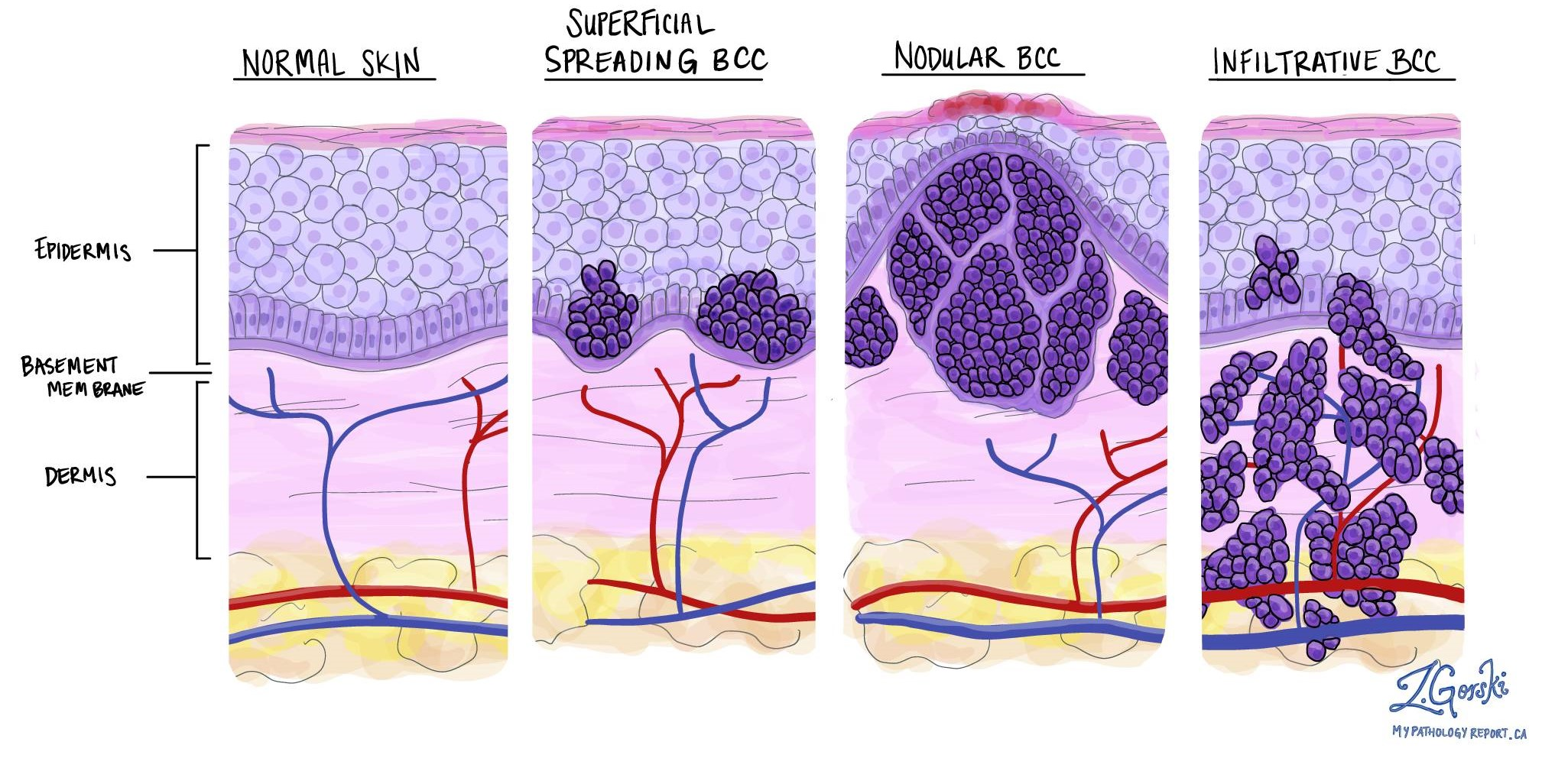
What Is Superficial BCC?
Superficial BCC is a form of basal cell carcinoma that grows along the surface of the skin. It often appears as a flat, red or pink patch that may be scaly and have a slightly raised edge. People sometimes mistake it for eczema or psoriasis because it can be a persistent dry, scaly area.
It is commonly found on the trunk (like the chest, back, or shoulders), but can occur elsewhere. “Superficial” means it is completely confined to the epidermis (the top layer of skin) and hasn’t yet learnt how to invade deeper into the skin.
Do I Need Further Tests?
No, not for superficial BCC. Superficial BCC does not spread to lymph nodes or organs, so scans or lymph node checks are not needed. Doctors don’t routinely do blood tests or imaging for any BCC unless there’s something very unusual about it. With superficial BCC it’s even less of a concern because it’s a mild subtype. Your treatment and follow-up skin exams are all that’s necessary.
Prognosis
The prognosis for superficial BCC is outstanding. It is highly curable. Once treated properly, it is unlikely to recur. There is a small chance the lesion could come back in the same spot if any cells were left behind — for example, if treated with a cream and a small focus persists, which would need re-treatment.
Superficial BCC has virtually no risk of metastasis (spreading), and it very rarely causes any serious damage. The main thing to remember is to protect your skin from sun to prevent future lesions and attend follow-ups — because having one BCC means you could get another in time.
Symptoms
- A flat, red or pink patch — often slightly scaly, with a faintly raised edge
- Persistent rather than healing — present for weeks to months
- Commonly on the trunk (chest, back, shoulders) but can occur anywhere
- Sometimes mistaken for eczema or psoriasis because it doesn't go away with moisturiser
- May have a slightly shiny or pearly border
Causes & contributors
- Cumulative ultraviolet (UV) exposure from sunlight and solariums
- Fair skin, light eyes, easy burning
- Older age (though younger patients with significant sun damage are common in Australia)
- Personal or family history of skin cancer
- Immunosuppression (eg. transplant recipients)
Diagnosis
Diagnosis is usually made by a doctor on clinical examination and dermatoscopy and confirmed on histology after a small biopsy. The pathology report names the subtype — "superficial BCC" specifically means the cancer is confined to the epidermis and has not crossed the basement membrane into the dermis below. No scans, blood tests or lymph node checks are needed because superficial BCC does not metastasise.
Treatment options
Topical imiquimod (Aldara) →
A prescription cream applied for around six weeks that stimulates the immune system to attack the cancer. Cleared at home; visible inflammation during treatment is expected.
Laser-assisted photodynamic therapy (LA-PDT) →
Laser ablation of the visible tumour followed by a photosensitising cream and red-LED light activation. Doctor-led, in-clinic, short downtime, excellent cosmetic outcomes — one of the most common techniques we use for superficial BCC.
Curettage and electrodessication
The area is numbed, the lesion is scraped out, and the base is cauterised. Typically leaves a round, pale scar. A pragmatic option when a patient has multiple lesions and prioritises convenience.
Surgical excision
Cut out under local anaesthetic with a small margin of normal skin. Used selectively for superficial BCC when other options are not suitable.
When to see a doctor
See a doctor if you have a flat, pink or red patch on sun-exposed skin that has been present for weeks to months and is not healing — especially if you have treated it as eczema or psoriasis without improvement. A simple biopsy can confirm the diagnosis and many effective treatments are available.
Frequently asked questions
-
Is superficial BCC cancer?
Yes. Superficial BCC is a skin cancer — the mildest subtype of basal cell carcinoma. It is confined to the epidermis (the very top layer of skin) and has not crossed the basement membrane into the dermis. Because the blood and lymph vessels cancer uses to spread exist only in the dermis, superficial BCC has virtually no risk of metastasis. It does still need treatment, but it is highly curable. -
What does superficial BCC look like?
A flat, red or pink patch with a faintly raised edge — often slightly scaly. It is usually painless. The defining feature is persistence — it stays put for weeks to months and does not heal with moisturiser or simple skincare. Most commonly found on the trunk (chest, back, shoulders), though it can occur anywhere. -
How is superficial BCC different from eczema or psoriasis?
Eczema and psoriasis typically come and go, respond to topical steroids or moisturisers, and often itch. Superficial BCC sits on the same spot, slowly enlarges over months, and does not respond to standard skin-condition creams. If a "patch of eczema" has been on the same site for more than 6–8 weeks without improvement, ask a skin doctor to assess it. -
Can superficial BCC be treated with cream instead of surgery?
Yes — that is one of the standard treatments. Prescription imiquimod (Aldara) is applied at home for around six weeks and stimulates the immune system to clear the cancer. It works well for selected superficial BCCs but causes visible inflammation during treatment. Laser-assisted photodynamic therapy (LA-PDT) is an in-clinic alternative that is also non-surgical. -
How effective is laser-assisted PDT for superficial BCC?
Laser-assisted PDT is highly effective for superficial BCC — up to ~100% initial clearance with strong long-term recurrence-free rates. It is doctor-led and completed in clinic, with short downtime (usually a few days) and excellent cosmetic results. We use it regularly for superficial BCC. -
Does superficial BCC spread to lymph nodes or other organs?
Virtually never. Superficial BCC is confined to the epidermis, and the blood and lymph vessels cancer needs to spread are only found in the dermis below. No CT scans, PET scans, blood tests or lymph node biopsies are needed. -
Can superficial BCC come back after treatment, and what is the risk of getting another skin cancer?
Recurrence at the same site is uncommon but possible — most often if treatment did not reach every cell. If a small focus persists it is easily re-treated. Separately, having had one BCC means your skin has shown susceptibility — about 50% of patients develop another non-melanoma skin cancer within 5 years. This is why structured skin checks and lifelong sun protection matter.
References
- Clinical practice guidelines for keratinocyte cancer. Cancer Council Australia. (NHMRC-approved 2019.)
- Guidelines of care for the management of basal cell carcinoma. J Am Acad Dermatol. 2018. (American Academy of Dermatology.)DOI: 10.1016/j.jaad.2017.10.006
- Basal cell carcinoma — a narrative review on contemporary diagnosis and management. Oncol Ther. 2022.DOI: 10.1007/s40487-022-00201-8
Related
Medically reviewed by Dr Christopher Irwin, MBChB, FRACGP, MMed (Skin Cancer), FACAM, MSCCA · Last reviewed 2026-06-06 · Editorial policy