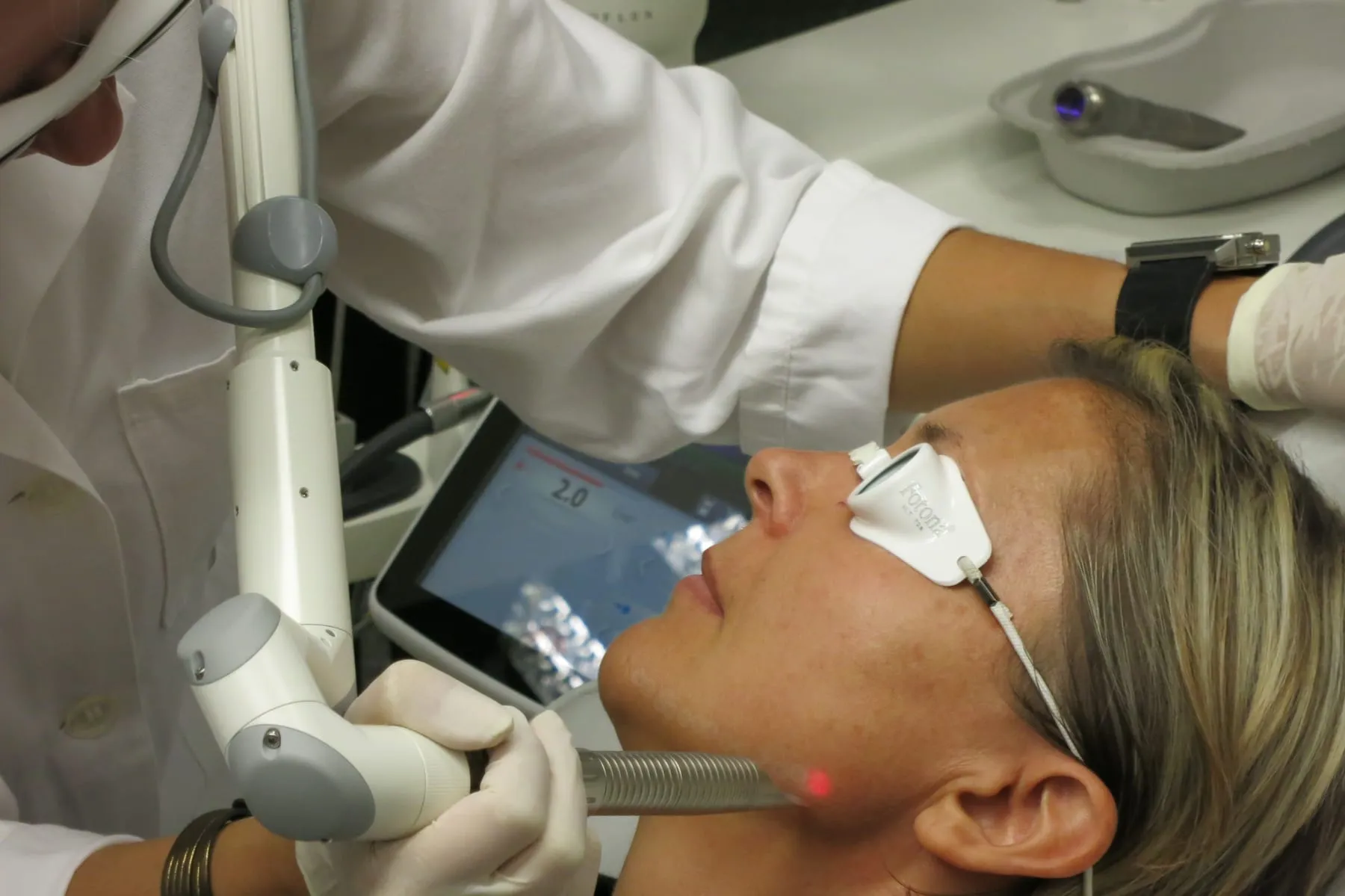
- Four-step layered laser facelift in one 60–90 minute session.
- Intraoral SmoothLiftin™ treats the mid-face from inside the mouth — unique to Fotona 4D®.
- Combines Er:YAG (resurfacing) and Nd:YAG (deep heating) wavelengths.
- 3–4 sessions spaced 4 weeks apart for best tightening and longevity.
- Short recovery time — typically 24 hours of mild redness, light flaking possible for 1–3 days; most return to normal activities immediately.
- Suitable for most Fitzpatrick skin types — melanin-rich skin via the Skin of Colour Clinic.
- Best for mild–moderate laxity; we'll refer to surgical opinion honestly for severe laxity.
- Sequenced carefully around any recent injectables or threads.
- Annual maintenance after the initial course preserves results.
- Available at our Ivanhoe clinic.
Quick definition
Fotona 4D® is a doctor-led non-surgical facelift-style laser treatment that uses four coordinated passes in one 60–90 minute session — addressing volume, laxity, tone and texture at multiple skin depths. The four steps are SmoothLiftin™ (intraoral Er:YAG that treats the mid-face from inside the mouth — unique to Fotona 4D®), FRAC3® (fractional Nd:YAG for rejuvenation), PIANO® (deep dermal Nd:YAG bulk heating for tightening), and SupErficial™ (light surface micropeel for glow). Typical course is 3–4 sessions spaced 4 weeks apart, plus annual maintenance. Minimal downtime — usually 24 hours of mild redness. Suitable for mild-to-moderate laxity; we refer honestly to surgical opinion for severe laxity. Adaptable for melanin-rich skin via the Skin of Colour Clinic.
Fotona 4D® is a doctor-led, non-surgical facelift-style laser treatment designed to improve facial laxity, fine lines, texture and overall skin quality — without needles or surgery. It works at multiple depths, including an intraoral step that treats from the inside out, helping the face look fresher, more supported and more refined.
At The Skin Doctor, every Fotona 4D® plan is tailored to your skin, your ageing pattern and your downtime tolerance, with realistic expectations and staged results.
Best for
Fotona 4D® is ideal if you want:
- mild to moderate skin laxity and softening of facial contours
- early jowling and jawline blur
- improvement in smile lines and mid-face “heaviness”
- fine lines, rough texture and enlarged pores
- uneven tone and dullness
- a refreshed look without injectables or surgery
For body tightening, see Fotona 3D body tightening →.
What makes Fotona 4D® different
Many “tightening” treatments heat one layer of the skin. Fotona 4D® is different because it uses four coordinated steps to treat:
- Inside the mouth — the mid-face support zone (unique to Fotona 4D®)
- The dermis — collagen remodelling
- Deeper dermal layers — tightening
- The surface — texture and glow
This is why it can produce a more “complete” rejuvenation result than single-mode tightening.
How Fotona 4D® works
SmoothLiftin™ (intraoral tightening)
A gentle Er:YAG laser step performed inside the mouth to stimulate collagen where it supports the mid-face and lower-face region. This can soften the look of smile lines and improve overall facial support without adding filler volume.
FRAC3® (fractional rejuvenation)
Targets textural irregularities and visible imperfections using a fractional Nd:YAG pattern that promotes skin renewal and smoother tone.
PIANO® (deep dermal tightening)
A controlled deep-heating Nd:YAG step that warms the deeper dermis to support firmness and tightening while maintaining skin safety.
SupErficial™ (laser micropeel)
A final Er:YAG surface polish to refine texture, reduce roughness and boost radiance. Depending on intensity, some patients notice light flaking over 1–3 days.
Results and treatment course
Most patients notice:
- early glow and smoother texture within days
- progressive tightening and refinement over weeks to months as collagen remodels
Typical plans:
- One session for a refreshed, pre-event result
- 3–4 sessions spaced 4 weeks apart for best tightening and longevity
- Annual maintenance depending on goals and ageing pattern
See the Results timeline below for typical milestones.
Fotona 4D recovery time — how much downtime is there?
Recovery time is short — most patients return to normal activities immediately, and the typical downtime is about 24 hours of mild redness. Day by day, most patients experience:
- Day of treatment — skin feels warm and looks mildly red, similar to a brief sunburn.
- Day 1 — redness usually settling; makeup can usually be worn from today.
- Days 1–3 — possible light surface flaking from the SupErficial™ micropeel step.
- First 48 hours — avoid strenuous exercise and heat (hot showers, sauna).
- From week 2 onward — no visible recovery signs; collagen remodelling continues quietly over the following weeks to months.
Daily SPF 50+ and gentle skincare are the only ongoing requirements. Downtime can be slightly longer if your session uses a more intensive surface setting — your doctor will tell you what to expect for your plan before treating.
Why choose The Skin Doctor
- doctor-led laser assessment and treatment planning
- conservative, staged approach focused on natural outcomes
- settings tailored to skin type, sensitivity and pigmentation risk
- clear expectations, clear aftercare and structured follow-up
Learn more
Official overview: fotona4d.com
Related face pages
What to expect
-
Medical assessment and skin consultation
A 20-minute consultation with Dr Chris to review your skin, medical history, prior procedures (laser, injectables, surgery), medications including photosensitisers and isotretinoin, and treatment goals. Realistic expectations and the staged plan are discussed before scheduling.
-
Cleansing, photography and preparation
Skin is cleansed and baseline clinical photographs are taken. The four-step laser sequence is set up, eye protection fitted, and any pain-management options discussed.
-
Four-step laser sequence
SmoothLiftin™ (intraoral Er:YAG for mid-face support), FRAC3® (fractional Nd:YAG for texture and tone), PIANO® (deep dermal bulk heating for tightening), and SupErficial™ (light surface laser micropeel for glow). Each pass targets a different depth and concern in one coordinated session.
-
Cooling, mask and post-care
Cooling, a soothing mask, SPF and written aftercare instructions before you leave. Makeup can usually be worn the following day.
-
Follow-up and maintenance planning
Second session typically scheduled at 4 weeks; the full course of 3–4 sessions is mapped out at consultation. Annual maintenance is typically recommended after the initial course.
Results timeline
- Immediately Skin feels firmer and tighter, with a visible glow. Mild redness usually settles within 24 hours; possible light surface flaking from the SupErficial™ step over 1–3 days.
- 2–4 weeks Early collagen response — improved texture, tone and a smoother surface. Subtle tightening becomes noticeable.
- 3 months Full collagen remodelling becomes visible. Lifting, jawline definition and contour improvement most apparent after a course of 3–4 sessions.
- 6–12 months and beyond Maintenance phase. Annual top-up sessions plus daily SPF 50+ preserve gains. Without maintenance, natural ageing resumes its trajectory.
Ideal candidate
- Mild to moderate skin laxity and softening of facial contours
- Early jowling and jawline blur — pre-surgical or instead of surgical correction
- Smile lines and mid-face "heaviness" where filler is not the preferred option
- Fine lines, rough texture and enlarged pores
- Uneven tone, dullness or loss of skin radiance
- Patients who want a layered multi-depth treatment rather than a single laser pass
- Patients prepared to commit to a course of 3–4 sessions for best collagen remodelling
- Suitable for most Fitzpatrick skin types when carefully planned — melanin-rich skin via the Skin of Colour Clinic
- Patients comfortable with subtle, progressive change rather than dramatic overnight lifting
Frequently asked questions
-
Is Fotona 4D® painful?
Most patients describe warmth or mild heat rather than pain. The intraoral SmoothLiftin™ step is usually well tolerated — it feels warm but is not sharp. Settings are tailored to your comfort and safety, and topical numbing or air cooling can be used where helpful. Patients comfortable with laser hair removal or IPL typically find Fotona 4D® very manageable. -
Does Fotona 4D® replace a facelift?
It can deliver meaningful improvement for mild to moderate laxity, but it does not replicate surgical facelift outcomes in severe laxity. For heavier jowling or significant neck banding a surgical opinion is the honest answer — we will say so rather than recommending repeated non-surgical sessions that cannot deliver the result you want. Fotona 4D® works very well as pre-surgical maintenance, post-surgical skin-quality support, or as a long-term non-surgical alternative for the right candidate. -
How long do results last?
Results develop over weeks to months as collagen remodels and peak around 3 months after a full course of 3–4 sessions. The new collagen does not disappear overnight, but natural ageing continues — so annual maintenance sessions plus daily SPF 50+ are typically required to preserve and extend the gains. -
How many sessions will I need?
Most patients have a course of 3–4 sessions spaced 4 weeks apart for best tightening and longevity. A single session can give a refreshed result for pre-event preparation, but the cumulative effect of a course is significantly stronger. Annual maintenance after the initial course preserves the result. -
Can I combine Fotona 4D® with other treatments?
Yes — many patients combine it with collagen-stimulating injectables, pigment-management programs, RF microneedling or chemical peels depending on goals. Sequencing matters (e.g. injectables typically performed BEFORE deep laser heating, with appropriate intervals), and we plan the order at consultation to protect any work you have already had done. -
Is Fotona 4D® safe for melanin-rich (Fitzpatrick IV–VI) skin?
Yes, with appropriate settings and pre-conditioning. Nd:YAG wavelengths used in the deeper passes (FRAC3®, PIANO®) are well-suited to darker skin because they bypass surface melanin. The Er:YAG components (SmoothLiftin™, SupErficial™) are used at modified settings to reduce post-inflammatory hyperpigmentation risk, often with 4–6 weeks of pre-conditioning topical pigment-modulators. Care is delivered through our Skin of Colour Clinic when appropriate. -
What's the recovery actually like?
Most patients have 24 hours of mild redness — similar to a brief sunburn — and possible light flaking from the SupErficial™ surface step over 1–3 days. Makeup can usually be worn the following day. Avoid strenuous exercise and heat (hot showers, sauna) for 48 hours. Most patients return to normal activities immediately and find downtime far less than they expected. -
How long after Fotona 4D® can I go back to work?
Most patients can return to work the next day — many the same day. The typical recovery is around 24 hours of mild redness, and makeup can usually be worn the following day, which covers any residual pinkness. Light flaking from the surface micropeel step can occur over 1–3 days but does not usually interrupt work. If your session uses a more intensive surface setting, we will tell you beforehand so you can plan around it. -
I've had filler, anti-wrinkle injections or threads — does that affect treatment?
Usually no, but timing and disclosure matter. We need to know about any recent injectables or threads so we can plan device parameters and treatment timing appropriately. Some energy-based treatments can affect filler integrity if delivered too soon afterwards, so we coordinate the sequence to protect existing work. Recent injectables are not a barrier — but they do change the plan.
References
- OCT evaluation of intraoral non-ablative Er:YAG laser (SMOOTH mode) for nasolabial folds — a randomized split-face pilot study. Skin Res Technol. 2020.DOI: 10.1111/srt.12816
- Periocular rejuvenation using a non-ablative long-pulse 2940 nm Er:YAG laser. Lasers Med Sci. 2022.DOI: 10.1007/s10103-021-03362-6
Related
Medically reviewed by Dr Christopher Irwin, MBChB, FRACGP, MMed (Skin Cancer), FACAM, MSCCA · Published 2026-06-06 · Updated 2026-07-10 · Editorial policy