Doctor-led medical laser and light therapies in Melbourne. Dermoscopic safety screening before any pigment laser, Fotona SP Dynamis Pro (Er:YAG + Nd:YAG) for resurfacing, lifting and vascular work, Q-switched nanosecond Nd:YAG for pigment and tattoo, and Medilux medical-grade LED for inflammation and barrier repair. Conservative protocols for melanin-rich skin via the Skin of Colour Clinic.
- Every laser journey begins with a doctor-led medical assessment.
- Dermoscopic safety check on every pigmented lesion before any pigment laser is fired.
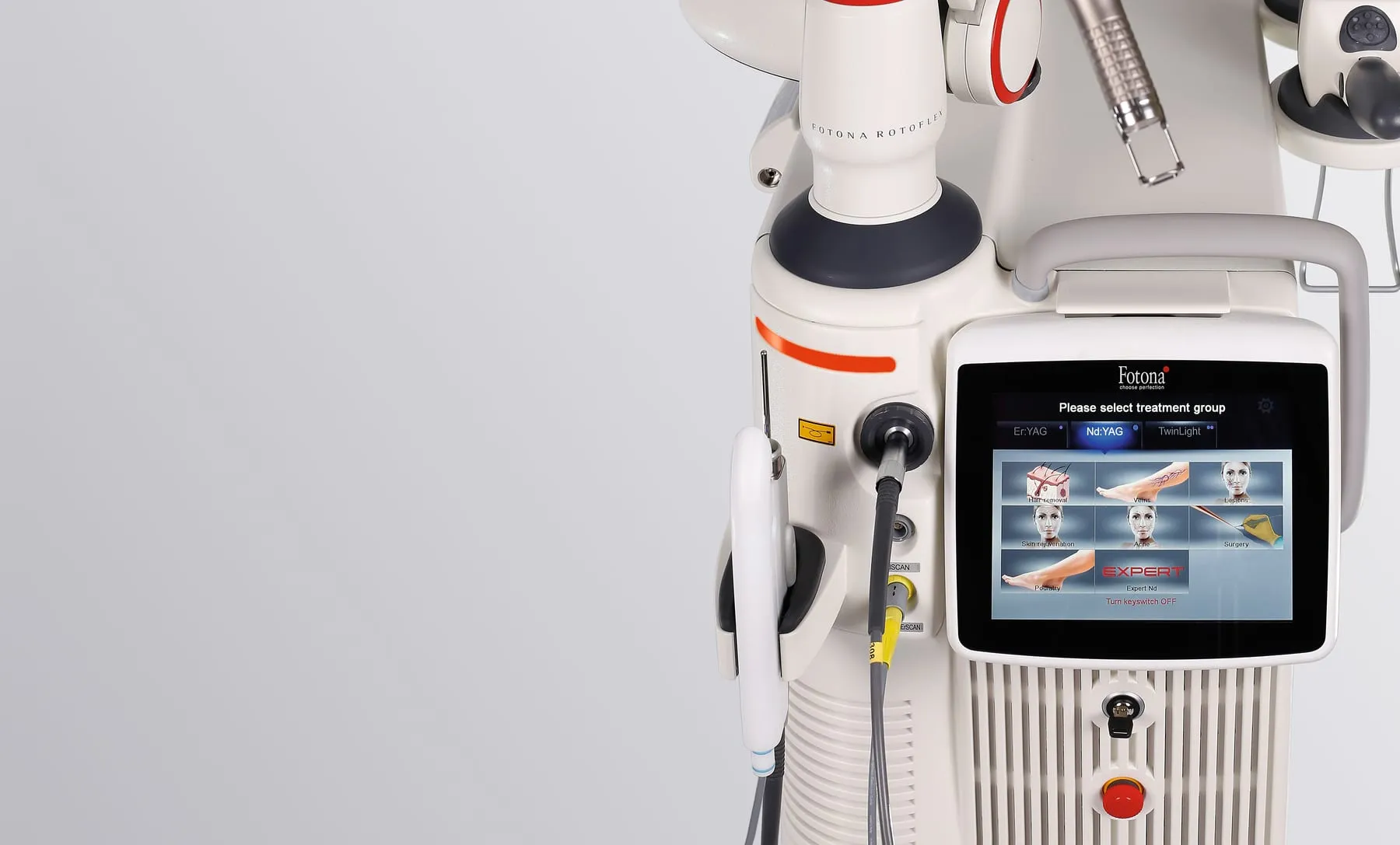
- Fotona SP Dynamis Pro combines Er:YAG and Nd:YAG wavelengths for resurfacing, lifting and vascular work.
- Q-switched nanosecond Nd:YAG is the gold standard for pigmentation and tattoo ink removal.
- Medilux medical-grade LED supports inflammation, redness and barrier healing across acne and rosacea protocols.
- Conservative wavelengths and longer intervals for melanin-rich skin via the Skin of Colour Clinic.
- Q-switched (nanosecond) is preferred over picosecond in our patient mix for a more predictable thermal profile.
- Most structural remodelling or pigment pathways need 3–6 sessions for stable, long-term results.
- We treat conditions — acne, rosacea, pigmentation, melasma, ageing — not isolated spots.
- Care provided across two Melbourne clinics — Ivanhoe and Diamond Creek.
Laser & Light Treatments
Doctor-led medical laser and light therapies in Melbourne. Dermoscopic safety screening before any pigment laser, Fotona SP Dynamis Pro (Er:YAG + Nd:YAG) for resurfacing, lifting and vascular work, Q-switched nanosecond Nd:YAG for pigment and tattoo, and Medilux medical-grade LED for inflammation and barrier repair. Conservative protocols for melanin-rich skin via the Skin of Colour Clinic.
Quick definition
Medical laser and light treatments at The Skin Doctor use calibrated light energy to trigger cellular repair, fragment unwanted pigment, clear vascular spots, stimulate structural collagen and settle inflammation. Every laser journey begins with a medical assessment to confirm your skin is healthy, stable and a safe candidate for light-based therapy — and a dermoscopic safety screen of pigmented lesions before any pigment laser is fired. We run three platforms: Fotona SP Dynamis Pro (Er:YAG + Nd:YAG), Q-switched nanosecond Nd:YAG for pigment and tattoo, and Medilux medical-grade LED for inflammation and barrier support.
Advanced medical laser and light therapies are not cosmetic “add-ons” — they are powerful tools of biophysics. At The Skin Doctor we use light energy to trigger cellular repair, stimulate structural collagen and clear pathological pigment with surgery-level precision. (1)
Because we are a medical-led clinic, every laser journey begins with a clinical assessment to ensure your skin is healthy, stable and a safe candidate for light-based therapy.
The medical advantage — why doctor-led matters
Laser–tissue interaction is complex science. Successful outcomes depend on expert selection of wavelength, pulse duration and energy levels tailored to your unique biology. (1,2)
Expert cancer screening
As a skin cancer clinic, we perform a dermoscopic check on all pigmented lesions before any pigment laser treatment. It is critically important that anyone removing pigmented lesions with laser has expertise in the early diagnosis of skin cancer — to ensure a malignancy is not being masked, mistreated or seeded.
Skin of colour safety
We specialise in care for melanin-rich skin. Specific wavelengths and conservative, staged plans minimise the risk of post-inflammatory hyperpigmentation (PIH). (3,4) Care for Fitzpatrick IV–VI is delivered through our Skin of Colour Clinic →, with pre-conditioning topicals, longer intervals and lower fluences.
Longevity and biostimulation
We view laser as a tool for “prejuvenation.” By signalling your mitochondria and fibroblasts to behave like younger cells, we support long-term cellular health rather than chasing temporary aesthetic trends. (5)
Our advanced platforms
Fotona SP Dynamis Pro
The “Ferrari” of medical lasers, the Fotona system combines two complementary wavelengths — Er:YAG and Nd:YAG — for deep structural remodelling. The platform is capable of everything from non-surgical lifting and tightening to gentle resurfacing and vascular clearing. By treating the skin in multiple layers (and even from within the oral cavity for jawline lifting), we stimulate significant collagen production with minimal downtime. (1)
Q-switched medical laser
The Q-switched nanosecond Nd:YAG is designed for high-precision pigment targets. By delivering energy in nanoseconds, the laser fragments unwanted pigment or tattoo ink into microscopic particles for immune clearance — while leaving the surrounding healthy skin “quiet” and undisturbed. (2,6) It is our preferred choice for stubborn sun spots, PIH and tattoo removal.
Medilux LED photomedicine
Medical-grade LED uses specific wavelengths of light to influence cellular behaviour at a mitochondrial level. We integrate Medilux into almost every acne and inflammatory protocol to reduce redness, settle inflammation and accelerate barrier healing. (5)
Specialised care pathways
We treat conditions, not just “spots.” Explore how laser fits into our integrated medical plans:
- Acne & acne scarring
- Rosacea & facial redness
- Pigmentation & tattoo removal
- Melasma management
- Collagen stimulation & longevity
- Vascular spots & capillaries
- Peri-oral / peri-orificial dermatitis
- Skin of Colour Clinic
What laser does not treat
Laser is powerful but not universal. We will recommend against laser — or sequence it differently — in several scenarios:
- Suspicious or atypical pigmented lesions are biopsied first, never lasered blind. Lasering a melanoma masks it and can seed cells. (2)
- Active melasma typically rebounds darker after aggressive laser. First-line is strict broad-spectrum SPF (including visible light via iron-oxide tinted sunscreen), topical pigment-modulators and lifestyle/hormone review. (3,4)
- Active inflammatory flares (severe acne flare, uncontrolled rosacea, eczema) are stabilised medically before any laser is fired.
- Recent isotretinoin or systemic retinoid therapy requires a wash-out period to reduce scarring risk for ablative or fractional work.
- Recent UV exposure or active sun-tan in pigment-laser candidates increases burn and PIH risk — treatment is deferred.
Book a consultation
References
- DermNet NZ — Laser treatment overview.
- Ross EV, et al. Comparison of responses of tattoos to picosecond and nanosecond Q-switched lasers. Arch Dermatol. 1998.
- Arora P, et al. Lasers for treatment of melasma and post-inflammatory hyperpigmentation. Lasers Med Sci. 2012.
- Davis EC, Callender VD. Postinflammatory hyperpigmentation: a review of the epidemiology, clinical features, and treatment options in skin of color. J Clin Aesthet Dermatol. 2010.
- Avci P, et al. Low-level laser (light) therapy (LLLT) in skin: stimulating, healing, restoring. Semin Cutan Med Surg. 2013.
- Kim JS, et al. Objective evaluation of the effect of Q-switched Nd:YAG laser on solar lentigines. Ann Dermatol. 2015.
Remodelling
Collagen Stimulation
Treatments that activate the skin’s natural regeneration.
Pigment
Pigmentation & Tattoo Removal
Q-switched nanosecond Nd:YAG for sun spots, freckles, PIH and tattoos.
Vascular
Vascular & Capillaries
Targeted laser for facial redness, broken capillaries and small vessels.
Resurfacing
Facial Resurfacing
Er:YAG and Nd:YAG resurfacing for texture, scarring and ageing.
Fractional
Frac3 Fractional Laser
Non-ablative fractional Nd:YAG for texture, acne and acne scarring.
Lifting
Fotona 4D Non-Surgical Facelift
Four-step laser facelift targeting tone, tightening and texture.
Safety
Skin of Colour — Safe Laser Care
Long-pulsed Nd:YAG and conservative protocols for melanin-rich skin.
Frequently asked questions
-
Is laser treatment safe if I have many moles?
Yes, but only if performed by a clinic with skin cancer expertise. We dermoscopically check every pigmented spot before any pigment laser is fired to ensure no suspicious lesion is treated or masked. Our background in skin cancer medicine means pigmented lesions are assessed for melanoma risk before any laser — a step many cosmetic clinics skip. -
How many sessions will I need?
Medical-grade laser is a journey. Some vascular spots clear in one session; sun spots often clear in 1–4 Q-switched sessions; structural collagen remodelling or pigment pathways typically need 3–6 sessions for stable, long-term results; professional tattoos commonly need 5–10+ sessions with deliberate spacing for safe immune clearance. -
Why does doctor-led laser matter?
Laser–tissue interaction is complex biophysics. Outcomes depend on accurate wavelength selection, pulse duration and energy tailored to your skin biology — and on safe screening of pigmented lesions before any treatment. Doctor-led practice means the device is chosen for your skin, not your skin for the device. -
Is laser safe for melanin-rich skin?
Yes, with specific wavelengths and conservative, staged plans — delivered through our Skin of Colour Clinic. We use long-pulsed and Q-switched Nd:YAG (the wavelengths that bypass surface melanin best), pre-condition the skin with topical pigment-modulators for 4–6 weeks before treatment, use lower fluences with longer intervals, and combine with iron-oxide tinted SPF to minimise the risk of post-inflammatory hyperpigmentation (PIH). -
What does laser actually treat (and not treat)?
Laser treats acne and acne scarring, rosacea and facial redness, sun spots and freckles, post-inflammatory hyperpigmentation, vascular spots and broken capillaries, tattoo ink, ageing-related texture and laxity, and selected structural concerns via collagen stimulation. It is not first-line for melasma (which can rebound darker), suspicious or atypical pigmented lesions (which need biopsy first), or active inflammatory flares (which need stabilising before treatment). -
What is the downtime after laser treatment?
Downtime depends on the platform and depth. Q-switched pigment work typically leaves a temporary frost or fine crust resolving over 7–14 days. Vascular laser may cause mild bruising for 3–7 days. Non-ablative collagen and gentle resurfacing usually show pinkness or mild swelling for 2–5 days. Deeper fractional resurfacing may need 5–10 days of social downtime. Medilux LED has no downtime. Your individual plan is set at consultation. -
How is medical-grade LED (Medilux) different from at-home LED masks?
Medilux is a medical-grade LED platform with calibrated wavelengths, validated energy output and clinically evidenced parameters — designed to influence cells at a mitochondrial level. At-home LED masks vary widely in output, wavelength accuracy and dose, and most fall well below the therapeutic threshold for measurable change. We use Medilux to settle acne inflammation, reduce redness and accelerate barrier healing as an adjunct to medical treatment, not as a standalone cosmetic gadget. -
Do I need a referral?
No referral is required. Both clinics — Ivanhoe and Diamond Creek — follow the same pathway: a 20-minute medical assessment with Dr Chris to confirm laser is appropriate, screen pigmented lesions and set the plan, followed by a session with our Lead Dermal Therapist. You can book directly via the booking panel in the sidebar.
Medically reviewed by Dr Christopher Irwin, MBChB, FRACGP, MMed (Skin Cancer), FACAM, MSCCA · Last reviewed 2026-06-06 · Editorial policy