
- Prescription chemotherapy cream for actinic keratosis (AK, precancer) and squamous cell carcinoma in situ (SCCis).
- Preferentially targets fast-dividing precancer/cancer cells.
- Typical courses are twice-daily application — 4 weeks for AK, 6 weeks for SCC in situ.
- Causes a progressive red, sore, crusted reaction from days 5–7 onward.
- Many face-treatment patients take 2–4 weeks off work.
- Not for use in pregnancy, breastfeeding or in known DPD deficiency.
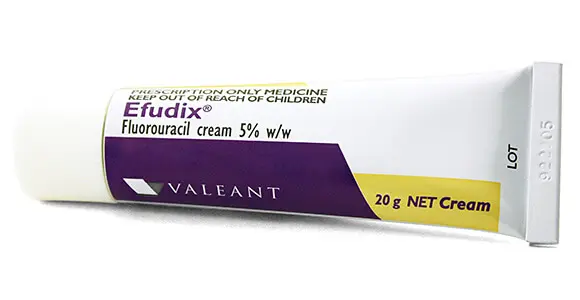
Efudix (5-fluorouracil) is a prescription field treatment cream commonly used in Australia for actinic keratosis (solar keratosis) and squamous cell carcinoma in situ (SCC in situ / Bowen’s disease / intraepidermal carcinoma).
Efudix (5-fluorouracil) works well — but it can be uncomfortable and visually dramatic during treatment. This page explains how Efudix (5-fluorouracil) works, how to apply it safely, what the reaction typically looks like, and when to contact your doctor.
In the USA, the same medicine is commonly spelled Efudex (5-fluorouracil).
Efudix or laser-assisted photodynamic therapy (LA-PDT)?
Efudix is one of several ways to treat actinic keratosis. For widespread sun damage, LA-PDT clears the field in a single in-clinic session — instead of weeks of daily cream.
| AK clearance | SCC in situ clearance | Course & downtime | Cosmetic outcome | |
|---|---|---|---|---|
| Laser-assisted PDT | ~92% complete clearance 13,14 | ~93.8% clearance 16 | 1 in-clinic session; heals in 5–7 days | Excellent — minimal scarring or pigment change |
| Efudix (5-fluorouracil) | ~70–75% 2 | ~50–85% clearance 3,4 | Twice-daily cream at home for 4–6 weeks, depending on treatment goal (AK vs SCCis); weeks of reaction 2,15 | Good — some risk of pigment change |
Not sure which suits you? LA-PDT clears the field in one session with far less downtime — but Efudix is an effective, lower-cost option you can do at home. Read more about LA-PDT for actinic keratosis or skin cancer here, or book a 20-minute review with Dr Chris to discuss the best option for your skin.
Key takeaways
- Efudix (5-fluorouracil) targets fast-dividing precancer/cancer cells more than normal skin cells. 1
- Typical treatment lengths are often 4 weeks for actinic keratosis and around 6 weeks for SCC in situ / Bowen’s disease — but your doctor’s plan comes first.
- The reaction from Efudix (5-fluorouracil) often starts mildly, then becomes red, sore, crusted and sometimes oozy from about day 5–7 onward.
- Many patients using Efudix (5-fluorouracil) on the face take 2–4 weeks off work (timing varies).
- Avoid getting Efudix (5-fluorouracil) near eyes, nostrils, lips, or other sensitive sites unless your treating doctor has given specific instructions. If the sun damage is on the red surface of the lip — actinic cheilitis — creams are generally not the answer; see laser vermilionectomy for the procedural pathway.
How Efudix (5-fluorouracil) works
Efudix (5-fluorouracil) blocks an enzyme (thymidylate synthetase) that cells need to make DNA. Cells that are dividing need to make new DNA — so Efudix (5-fluorouracil) preferentially damages rapidly dividing abnormal cells (like actinic keratoses and SCC in situ) compared with normal skin cells. 1
How effective is Efudix (5-fluorouracil)?
Effectiveness depends on the diagnosis, how consistently Efudix (5-fluorouracil) is applied, the treatment duration, and the individual.
- For actinic keratosis, Efudix (5-fluorouracil) is one of the most effective field therapies. As a rough guide, it has around a 75% chance of removing at least 75% of the actinic keratosis in a treated area for about a year. 2
- For SCC in situ (Bowen’s disease), published cure rates vary widely — often quoted in the range of ~50–85% depending on factors such as duration and lesion characteristics. 3,4
For the highest certainty of cure (particularly higher-risk sites or lesions), discuss alternatives such as LA-PDT — for actinic keratosis or non-melanoma skin cancer — or surgery.
How long is a course of Efudix?
Efudix is used as a short, defined course rather than something applied indefinitely. For solar (actinic) keratoses it is usually applied once or twice daily and continued until the treated skin develops the expected inflammatory reaction — redness, scaling and crusting — which generally takes about two to four weeks, after which it is stopped. 5,6 That reaction is a normal part of how the cream works, and studies have found that a stronger local skin reaction is associated with better clearance of lesions. 6,7
Completing an adequate course matters, because shorter courses tend to clear fewer lesions than longer ones. This is seen most clearly in trials of the related lower-strength (0.5%) once-daily cream, in which patients were treated for one, two or four weeks: the four-week courses produced higher complete-clearance rates than the one-week courses. 8,9 Studies of the 5% cream — the strength used in Efudix — have generally applied it for two to four weeks and confirm it is an effective field treatment, although, as with all field therapies, some lesions can recur and a repeat course is occasionally needed. 10,11
There is limited published evidence on a single “ideal” length for the 5% cream specifically, and the most direct duration comparisons come from the lower-strength formulation rather than from Efudix itself. 12 For that reason the length is judged by how your skin responds rather than by a fixed number of days, and your doctor will guide you on when to stop. It is best not to stop early simply because of the skin reaction unless you have been advised to — and if the reaction becomes severe or distressing, please contact the clinic for advice rather than continuing or stopping on your own.
Where and how to apply
Where
Efudix (5-fluorouracil) is usually applied directly to the diagnosed lesion, plus a margin (commonly about 5 mm, but follow your doctor’s instruction).
Accuracy matters — especially near eyes, lips, nostrils, genitals and skin folds.
Step-by-step
- Wash the skin with warm water (avoid soap unless advised otherwise).
- Pat dry, then wait 10–15 minutes.
- Apply Efudix (5-fluorouracil) to the area your doctor has advised (lesion plus margin). Wear a disposable (nitrile) glove — or, for smaller or more precise spots, many patients prefer to dab it on with a cotton bud (Q-tip) or even the end of a matchstick, so they don’t have to glove up for a tiny area.
- Avoid mucous membranes (eyes, inside the nose, lips). If the treatment area is close to these, get specific instructions before starting.
- Always wash your hands thoroughly after applying — even if you wore a glove or used an applicator.
- Do not cover the area unless your doctor tells you to — occlusive dressings can intensify the reaction.
- After about 20 minutes, you can usually apply moisturiser, sunscreen and/or make-up as part of your routine.
- Efudix (5-fluorouracil) can take up to 2 hours to absorb — apply evening doses 2–3 hours before bed to reduce transfer to bedding.
Area limit
Do not treat an area larger than about 23 × 23 cm unless your doctor has specifically planned this.
How much to use
- Start with a pea-sized amount and spread it thinly.
- For “full face field treatment”, multiple pea-sized amounts may be used — but only if your doctor has specifically planned this.
What to expect
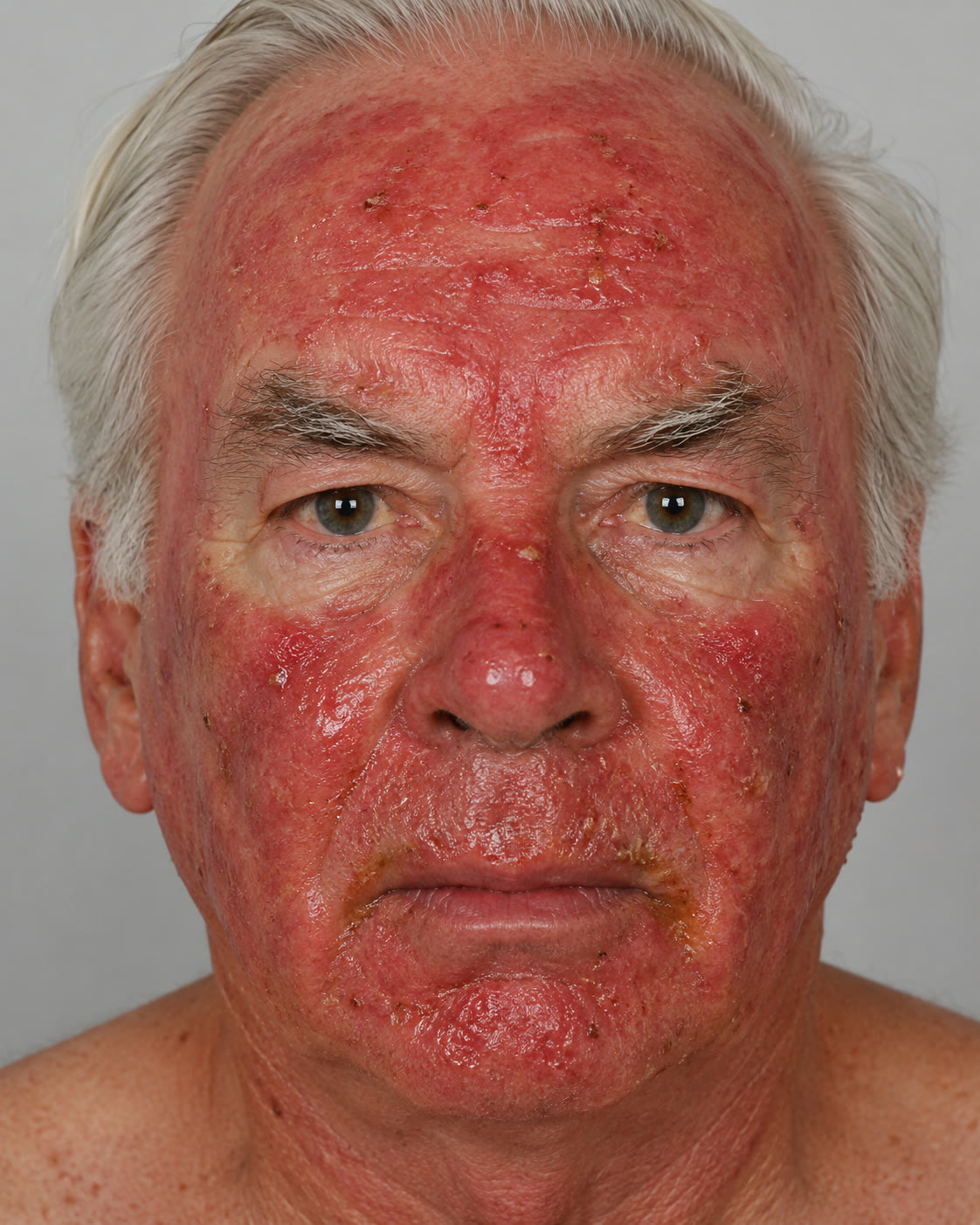
Be prepared — this is not a subtle treatment. Many patients describe the peak as the worst sunburn of their life, with the pain multiplied several times over, except that instead of fading after a day or two it keeps building over weeks. That dramatic reaction is the medicine doing its job on the sun-damaged cells.
A common pattern:
- Days 1–5: mild redness, dryness, mild stinging.
- Days 5–14: increasing redness, burning/tenderness, swelling; discomfort increases.
- Weeks 2–6: peak inflammation — cracking, crusting and sometimes ooze.
- After stopping: healing usually takes a further few weeks for the skin to settle.
Many people using Efudix (5-fluorouracil) on the face find facial movement (talking, eating, laughing) painful during the peak phase.
When to stop Efudix (Efudex)
The most important rule is simple: stop on the date your doctor has set — not when the reaction looks its worst, and not when the skin happens to look better for a day or two. Efudix (Efudex) works to a planned schedule, and the treatment length (often around 4 weeks for actinic keratosis and about 6 weeks for SCC in situ / Bowen’s disease) is chosen for your diagnosis and the area being treated.
Why finishing the planned course matters
It is common to want to stop early — the peak reaction (red, sore, crusted skin from about day 5–7 onward) can look alarming. But that reaction is the medicine working on the sun-damaged cells. Stopping too early, before the date your doctor set, can leave abnormal cells under-treated and lower the chance of clearing the area properly. If the reaction is hard to cope with, the answer is usually to contact your doctor — not to quietly stop — because there is often a way to adjust the plan.
When to stop or call sooner
Contact your doctor (or seek review) before your planned end date if you have:
- pain or disruption you genuinely cannot tolerate, despite simple measures;
- signs that worry you about infection (spreading redness, increasing pain, pus, fever) — noting that a normal Efudix (Efudex) reaction can look dramatic on its own, so when in doubt, get it checked;
- a reaction spreading well beyond the area you were asked to treat;
- any of the rare whole-body symptoms in the Rare but serious toxicity section below.
What the skin usually looks like at the end
By your planned stop date the treated area is typically red, crusted and tender — sometimes cracked or weeping at the peak. That is expected. It does not keep getting worse once you stop: from the day you finish, the skin begins to settle.
Aftercare and recovery
Once you stop Efudix (Efudex), the skin starts to heal — but it takes time, and a little aftercare helps it settle comfortably.
How long healing takes
Healing usually takes a further few weeks after your last application. Larger areas and facial “field” treatments generally take longer to settle than small spot treatments; many face-treatment patients take 2–4 weeks before they feel comfortable in public or back at work.
How to support (and speed up) healing
- Keep the skin clean and moisturised with a plain, bland moisturiser or emollient — this is the single most helpful thing for comfort and recovery.
- Wear daily SPF 50+ once the skin tolerates it, and avoid the sun while healing — freshly treated skin is very sensitive to UV.
- Do not pick or scrub crusts; let them lift on their own.
- Be gentle — pause active skincare (acids, retinoids, scrubs) until the skin has settled, unless your doctor advises otherwise.
Washing and moisturiser
You can usually wash the area gently with warm water and resume a plain moisturiser as the skin heals. (During treatment, many patients already apply moisturiser, sunscreen or make-up about 20 minutes after the cream has absorbed.) If anything stings sharply or the skin breaks down, ease off and check with your doctor.
Review
We review the treated area at around 6–8 weeks to confirm the lesion has cleared, decide whether any further treatment is needed, and set up your ongoing skin surveillance.
Common side effects
Common, expected local effects:
- redness, burning, stinging
- swelling and tenderness
- crusting / scabbing
- cracking and oozing
- sensitivity to heat and wind
These are part of the intended inflammatory response.
Less common risks
- Pigment changes (hyperpigmentation or hypopigmentation) — usually temporary, occasionally persistent.
- Scarring — uncommon, but possible. Often improvable with scar-focused treatments.
- Worsening facial redness (rosacea / telangiectasia) — discuss this risk if you have rosacea-prone skin.
- Non-healing ulcer — especially on the lower legs (poorer circulation).
- Infection — uncommon. Normal Efudix (5-fluorouracil) reactions can mimic infection. If unsure, seek review.
Who should not use Efudix (5-fluorouracil)?
Efudix (5-fluorouracil) should not be used if you are:
- pregnant
- trying to conceive
- breastfeeding
Always tell your doctor about your medical history and medicines before starting.
Rare but serious toxicity
Life-threatening toxicity from topical Efudix (5-fluorouracil) is extremely rare. Seek urgent medical care if you develop:
- severe abdominal pain or cramps, vomiting, or bloody diarrhoea
- swelling or soreness of the mouth or tongue
- fevers and chills (flu-like illness)
- feeling severely unwell out of proportion to the local reaction
DPD deficiency
A small number of people have dihydropyrimidine dehydrogenase (DPD) deficiency, which can reduce the body’s ability to break down 5-fluorouracil and may increase toxicity risk. If you or a family member has known DPD deficiency, tell your doctor before using Efudix (5-fluorouracil).
Alternatives
If Efudix (5-fluorouracil) doesn’t suit your lifestyle, pain tolerance, skin type or lesion pattern, alternatives may include:
- LA-PDT for AK
- LA-PDT for non-melanoma skin cancer
- Aldara (imiquimod) for selected lesions
- Lesion-directed options such as cryotherapy or procedural removal
Related pages
What to expect
-
Consultation and diagnosis
Clinical assessment, dermoscopy, and biopsy where there is any uncertainty about the diagnosis. We confirm the lesion is suitable for Efudix (5-fluorouracil) and rule out higher-risk subtypes that require surgery.
-
Written treatment plan
We give you a clear plan — area to treat (lesion plus a margin, typically 5 mm), how long to treat for (often 4 weeks for AK, around 6 weeks for SCC in situ), and what to expect at each phase.
-
At-home application
Apply Efudix (5-fluorouracil) twice daily (or as directed) using a nitrile glove, or a cotton bud (Q-tip) or matchstick for smaller, more precise spots. Avoid eyes, nostrils, lips, genitals and skin folds unless specifically advised. Always wash your hands thoroughly after each application.
-
Managing the reaction
Expect a progressive reaction — mild redness in week 1, ramping up to red, sore, crusted and sometimes weeping skin from days 5–7 onward. Moisturiser, sunscreen and make-up can usually be applied 20 minutes after Efudix (5-fluorouracil). Do not cover the area unless directed.
-
Stopping and recovery
Stop on the date your doctor has set. Healing usually takes a further few weeks. Daily SPF 50+, gentle skincare and sun avoidance support the recovery.
-
Review and surveillance
We review the treated area at around 6–8 weeks to confirm clearance, decide whether further treatment is needed, and enrol you in long-term skin surveillance.
Results timeline
- Days 1–5 Mild redness, dryness and mild stinging at the treated site.
- Days 5–14 Increasing redness, burning or tenderness, swelling. Discomfort builds.
- Weeks 2–6 Peak inflammation — cracking, crusting and sometimes weeping. Facial movement may be uncomfortable.
- After stopping Healing usually takes a further few weeks. Skin gradually settles back toward normal.
- 6–8 weeks after finishing Clinical review for clearance and to plan ongoing surveillance.
Ideal candidate
- Patients with actinic keratosis (sun damage pre-cancer) across a "field" of skin.
- Patients with biopsy-confirmed SCC in situ (Bowen's disease / intraepidermal carcinoma).
- Patients willing and able to follow a strict daily home regimen for 4–6 weeks.
- Patients who can tolerate visible inflammation and several weeks of cosmetic downtime.
- Patients who are not pregnant, breastfeeding or trying to conceive.
Frequently asked questions
-
Does Efudix (5-fluorouracil) mean I have skin cancer?
Efudix (5-fluorouracil) is used for both pre-cancers (actinic keratosis) and very early skin cancers confined to the top layer (SCC in situ / Bowen's disease). If you're unsure what your diagnosis is, ask your treating doctor to clarify. -
How long will I look "normal" after Efudix (5-fluorouracil)?
After finishing the course, most people take a few weeks for the skin to settle. Facial treatments often take longer than small spot treatments. Many patients using Efudix (5-fluorouracil) on the face take 2–4 weeks off work. -
Can I wear sunscreen or make-up over Efudix (5-fluorouracil)?
Many people apply moisturiser, sunscreen and/or make-up after Efudix (5-fluorouracil) has been on long enough to absorb (often around 20 minutes). -
What if I can't tolerate Efudix (5-fluorouracil)?
If Efudix (5-fluorouracil) is too painful or disruptive, contact your doctor early. You may be able to adjust the plan — or switch to options like LA-PDT or Aldara (imiquimod) depending on your diagnosis. -
Who should not use Efudix (5-fluorouracil)?
Efudix (5-fluorouracil) should not be used in pregnancy, while trying to conceive, or while breastfeeding. Tell your doctor about known DPD (dihydropyrimidine dehydrogenase) deficiency before starting. -
When should I stop using Efudix (Efudex)?
Stop on the date your doctor has set — not when the reaction looks its worst, and not just because the skin looks better for a day or two. The course length (often around 4 weeks for actinic keratosis and about 6 weeks for SCC in situ / Bowen's disease) is planned for your diagnosis. If you are struggling to continue, contact your doctor rather than stopping early — the plan can often be adjusted. -
Is it bad to stop Efudix (Efudex) early?
It can be. The peak reaction looks alarming but is the medicine working on sun-damaged cells; stopping before your planned end date can leave abnormal cells under-treated and reduce the chance of clearing the area. If the reaction is hard to tolerate, contact your doctor early to adjust the plan rather than quietly stopping. -
How can I speed up healing after Efudix (Efudex)?
After you finish the course, healing usually takes a further few weeks. Support it with a plain, bland moisturiser, daily SPF 50+ once tolerated, sun avoidance, and by not picking crusts. Pause active skincare (acids, retinoids, scrubs) until the skin settles. If anything looks infected or breaks down, get it reviewed.
References
- Longley DB, Harkin DP, Johnston PG. 5-fluorouracil — mechanisms of action and clinical strategies. Nat Rev Cancer (2003).
- Jansen MHE, et al. Randomized trial of four treatment approaches for actinic keratosis. N Engl J Med (2019). At 12 months, 5-fluorouracil gave the highest proportion of patients with at least a 75% reduction in lesions (74.7%).
- Morton CA, et al. British Association of Dermatologists' guidelines for the management of squamous cell carcinoma in situ (Bowen's disease) 2014. Br J Dermatol (2014).
- Bath-Hextall FJ, et al. Interventions for cutaneous Bowen's disease. Cochrane Database of Systematic Reviews (2013).
- Pomerantz H, Hogan D, Eilers D, et al. Long-term efficacy of topical fluorouracil cream, 5%, for treating actinic keratosis: a randomized clinical trial. JAMA Dermatol. 2015;151(9):952–960.
- Jury CS, Ramraka-Jones VS, Gudi V, Herd RM. A randomized trial of topical 5% 5-fluorouracil (Efudix cream) in the treatment of actinic keratoses comparing daily with weekly treatment. Br J Dermatol. 2005;153(4):808–810.
- Heppt MV, Trin K, Mille AC, Groc M, Delarue A, Bégeault N. Association between local skin reactions and efficacy with 5-fluorouracil 4% cream in actinic keratosis: a post-hoc analysis of two randomised clinical trials. Dermatol Ther (Heidelb). 2025;15(2):307–321.
- Jorizzo J, Stewart D, Bucko A, et al. Randomized trial evaluating a new 0.5% fluorouracil formulation demonstrates efficacy after 1-, 2-, or 4-week treatment in patients with actinic keratosis. Cutis. 2002;70(6):335–339.
- Weiss J, Menter A, Hevia O, et al. Effective treatment of actinic keratosis with 0.5% fluorouracil cream for 1, 2, or 4 weeks. Cutis. 2002;70(2 Suppl):22–29.
- Loven K, Stein L, Furst K, Levy S. Evaluation of the efficacy and tolerability of 0.5% fluorouracil cream and 5% fluorouracil cream applied to each side of the face in patients with actinic keratosis. Clin Ther. 2002;24(6):990–1000.
- Krawtchenko N, Roewert-Huber J, Ulrich M, Mann I, Sterry W, Stockfleth E. A randomised study of topical 5% imiquimod vs. topical 5-fluorouracil vs. cryosurgery in immunocompetent patients with actinic keratoses: a comparison of clinical and histological outcomes including 1-year follow-up. Br J Dermatol. 2007;157(Suppl 2):34–40.
- Askew DA, Mickan SM, Soyer HP, Wilkinson D. Effectiveness of 5-fluorouracil treatment for actinic keratosis—a systematic review of randomized controlled trials. Int J Dermatol. 2009;48(5):453–463.
- Choi SH, Kim KH, Song KH. Efficacy of ablative fractional laser-assisted photodynamic therapy with short-incubation time for the treatment of facial and scalp actinic keratosis: 12-month follow-up results of a randomized, prospective, comparative trial. J Eur Acad Dermatol Venereol. 2015;29(8):1598–1605.
- Choi SH, Kim TH, Song KH. Efficacy of iontophoresis-assisted ablative fractional laser photodynamic therapy with short incubation time for the treatment of actinic keratosis: 12-month follow-up results of a prospective, randomised, comparative trial. Photodiagnosis Photodyn Ther. 2017;18:105–110.
- Patel P, Wang J, Bitterman D, et al. Systematic review of randomized controlled trials of topicals for actinic keratosis field therapy. Arch Dermatol Res. 2024;316(4):108.
- Ko DY, Kim KH, Song KH. A randomized trial comparing methyl aminolaevulinate photodynamic therapy with and without Er:YAG ablative fractional laser treatment in Asian patients with lower extremity Bowen disease: results from a 12-month follow-up. Br J Dermatol. 2014;170(1):165–172.
Related
Related conditions
Medically reviewed by Dr Christopher Irwin, MBChB, FRACGP, MMed (Skin Cancer), FACAM, MSCCA · Last reviewed 2026-06-06 · Editorial policy