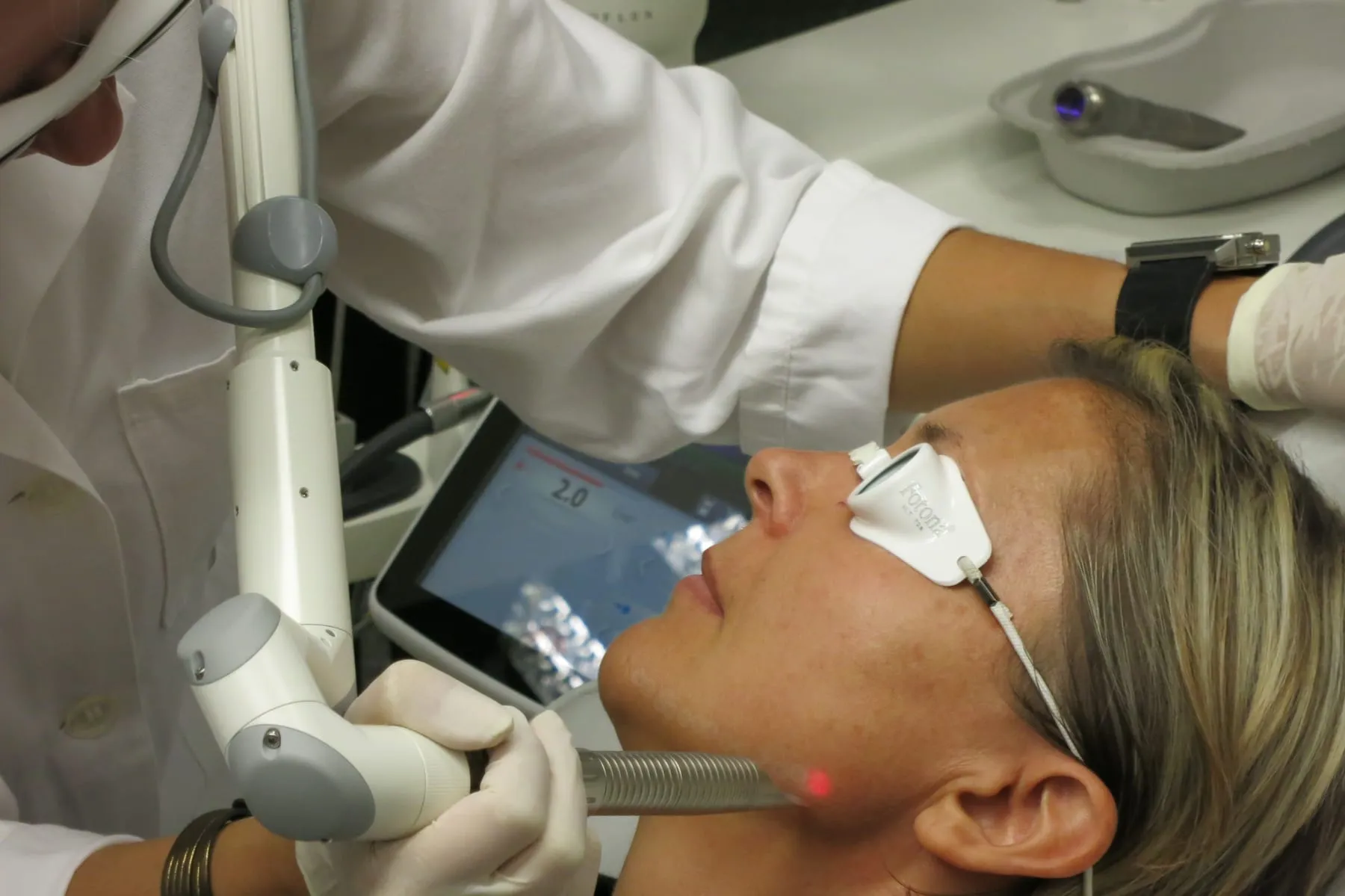
- ETR rosacea is mainly vascular — flushing evolves into persistent background redness and visible capillaries over time.
- Persistent redness and visible vessels often improve most with vascular laser because it targets the vessel network directly.
- Brimonidine 0.33% gel (Mirvaso) is best positioned as occasional special-occasion use, not daily long-term therapy.
- Long-pulsed 1064 nm Nd:YAG penetrates more deeply than shorter wavelengths and suits the thicker deeper vessels around the nose.
- Barrier repair reduces day-to-day reactivity and improves tolerance of both laser and medical therapy.
- The combined doctor plus dermal therapist appointment is usually the highest-yield starting point for ETR.
- Nd:YAG (1064 nm) has lower melanin absorption than shorter vascular wavelengths — relevant in pigmentation-prone skin.
- MBS item 14100 may apply in selected vascular cases when strict criteria are met; eligibility is individualised.
- A typical control course is 3 to 6 sessions, then maintenance every 6 to 18 months depending on triggers.
If your rosacea is mainly redness and flushing — with or without visible broken capillaries — you likely have erythematotelangiectatic rosacea (ETR). This subtype responds best when treatment addresses both the vascular driver (dilated, reactive facial blood vessels) and the skin barrier (sensitivity, burning, product intolerance). (1–4)
The highest-yield starting point for most patients is a combined appointment — 20 minutes with Dr Chris (diagnosis and medical or laser plan) followed by 40 minutes with a dermal therapist (barrier repair routine, trigger strategy, supportive LED where appropriate). The combination is often what turns rosacea from “constant flare-ups” into long stable periods.
What ETR rosacea looks like
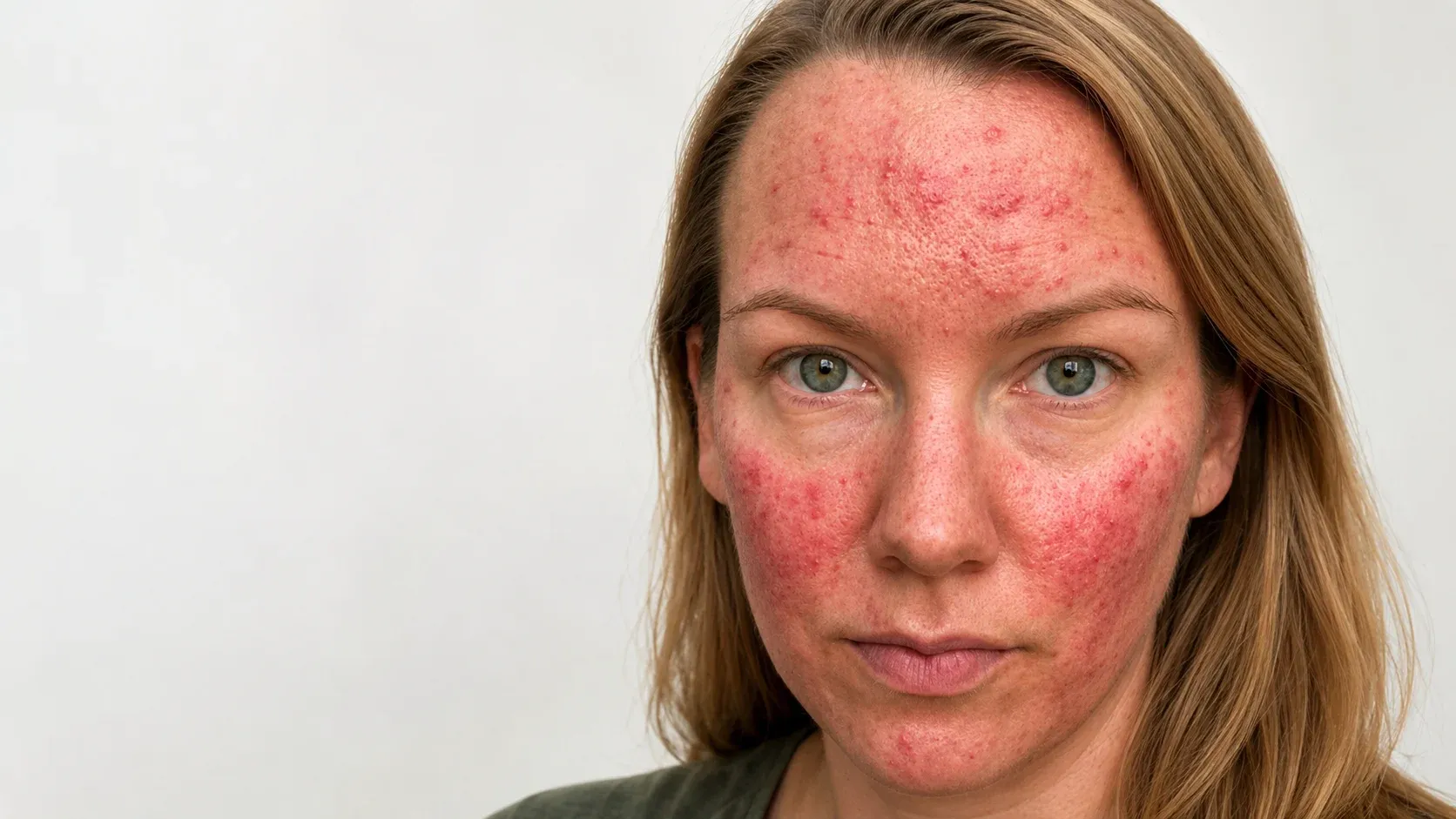
ETR rosacea typically includes:
- flushing triggered by heat, stress, alcohol, spicy foods, exercise, sun or wind
- persistent background redness that does not fully settle between flares
- visible capillaries (telangiectasia) on cheeks, nose, chin or around the nose
- sensitive, reactive skin — stinging, burning, intolerance to many products (1–4)
If your main issue is inflamed bumps and pustules rather than redness, the papulopustular rosacea plan is the more relevant pathway.
Why redness becomes persistent
Early rosacea is often on-and-off flushing. Over time, repeated vessel dilation and inflammation can contribute to:
- a larger network of permanently dilated superficial vessels
- more visible capillaries
- more persistent baseline redness (1–4)
This is why moisturisers can help comfort but often do not shift the visible vascular redness by themselves.
Step 1 — Stabilise the skin barrier (first 2 weeks)
This is the step most patients underestimate — and it is where the dermal therapist appointment makes a real difference.
Why barrier stabilisation matters
When the barrier is inflamed and leaky, you get:
- stinging and burning
- “everything makes me flare” product intolerance
- worse flushing from minor triggers
- poor tolerance of prescribed treatments (1–4)
What a dermal therapist adds
The dermal therapist appointment helps you:
- build a simple, tolerable routine (cleanser, moisturiser, sunscreen)
- identify ingredients to avoid (fragrance, harsh actives, alcohol-heavy products)
- choose the right format for your skin (cream vs gel vs lotion)
- plan supportive treatments such as calming LED between flare periods
- reduce day-to-day reactivity so vascular laser and medical therapy are better tolerated and longer-lasting
Step 2 — Identify your triggers (and keep living normally)
Triggers vary, but patterns are usually predictable. Rather than trying to avoid everything, aim to identify your top two triggers and manage them intelligently.
Common high-yield triggers:
- heat and hot showers
- sun exposure
- alcohol — especially red wine
- spicy foods and hot drinks
- stress and poor sleep
- exercise overheating — cooling strategies let you keep training (1–4)
The dermal therapist helps translate triggers into practical routines:
- sunscreen choice you will actually wear daily
- barrier support to reduce wind and heat reactivity
- post-exercise cooling and skincare steps
- product simplification to prevent irritant flares
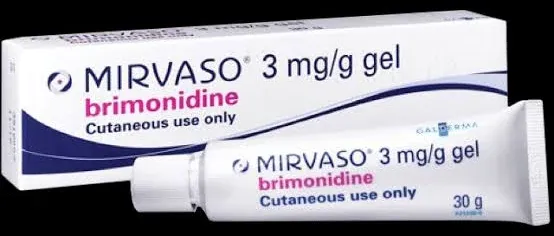
Brimonidine tartrate gel 0.33% (Mirvaso)
This is a redness-only prescription gel sometimes used for ETR rosacea. I’m not generally a fan of this medicine — you can’t use it often, or it worsens the rosacea (rebound rosacea). It does have a limited use case: for example, if there is a really important social event you want to look good for, but otherwise you’re not too fussed by your rosacea day to day. If you are using it for a special event, please test it a week or so beforehand — just so you understand what it looks like, and so it doesn’t actually make you look worse on your special day!
How it works
Brimonidine is an alpha-2 adrenergic agonist. It temporarily narrows superficial vessels (vasoconstriction), reducing visible redness for several hours. (5–8)
When it is useful
- short-term redness reduction for an event, presentation or photographs (5–7)
Why we position it as special-occasion use
Some patients experience worsening erythema or rebound redness as it wears off, or increased flushing during treatment. (5,8)
Practical approach:
- do a trial run on a normal day first
- use the smallest effective amount
- avoid applying to irritated skin
- stop if it worsens redness and switch strategies (5–8)
Brimonidine can reduce redness temporarily, but it does not remove visible capillaries — vascular laser is more direct for that. (9–11)
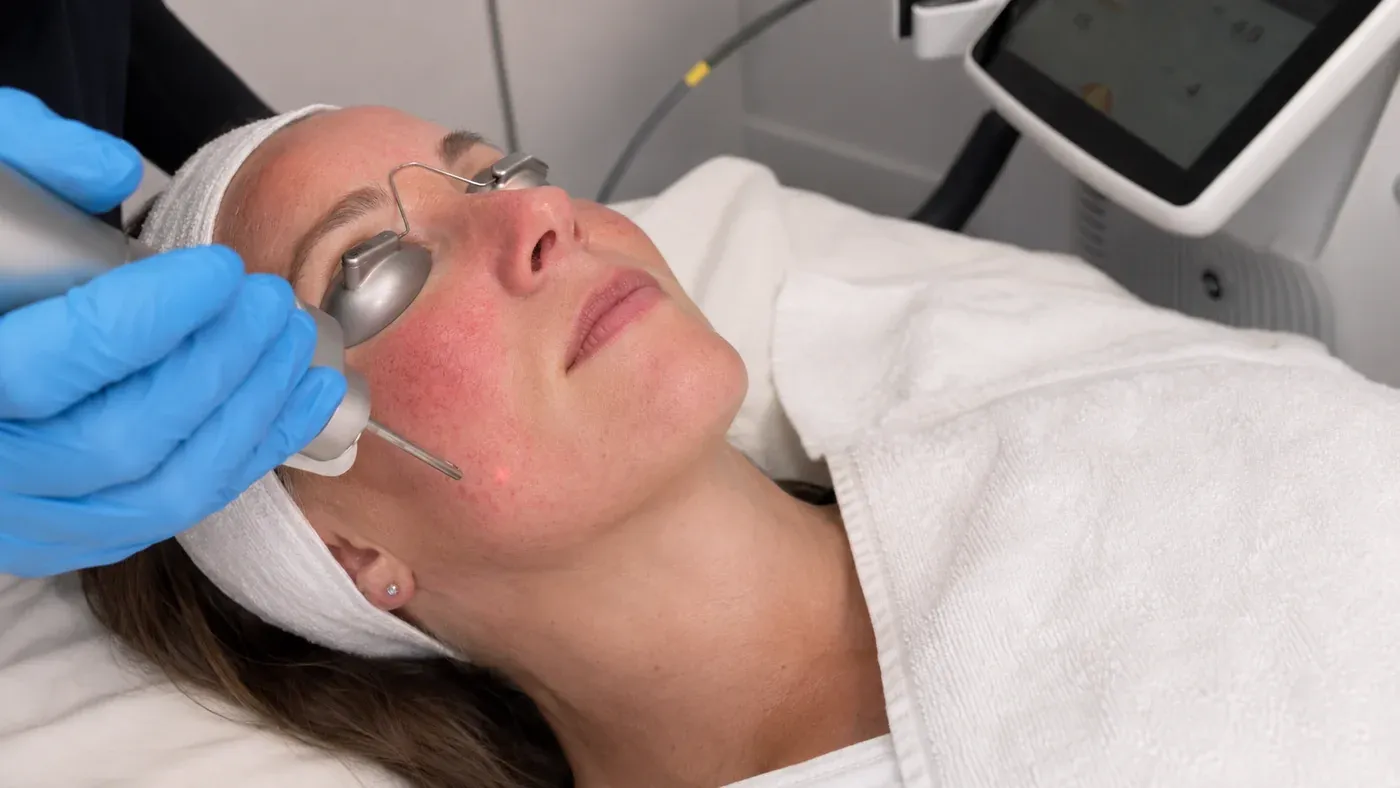
Step 3 — Vascular laser (Fotona SP Dynamis Pro Nd:YAG 1064 nm)
When persistent background redness and visible thread veins are the dominant problem, vascular laser is often the most effective treatment because it targets the blood-vessel network that creates the red appearance. Medications can help inflammation, flushing and bumps, but they often have limited impact on fixed background erythema and established telangiectasia — which is where laser steps in. (9–11)
Why 1064 nm Nd:YAG for ETR
Rosacea vessels are not always purely superficial. In many patients, part of the vascular load sits deeper in the dermis (particularly around the nose and central cheeks). The 1064 nm wavelength penetrates more deeply than many other vascular wavelengths, making it a strong option when deeper or thicker vessels contribute to persistent redness. (9–11)
That depth matters clinically. In rosacea-associated nasal telangiectasia, thicker, more dilated vessels respond better to Nd:YAG, while mild erythema with finer telangiectasia tends to respond better to pulsed dye laser (PDL). (13)
Translation: if your rosacea is vessel-dominant — especially thicker vessels and red zones around the nose — Nd:YAG is often a particularly good fit.
What the Fotona platform adds
The advantage is precise control of pulse structure, spot size and energy, so treatment is tailored to the vessel pattern we see on your face while prioritising skin safety and comfort.
The 1064 nm wavelength also has relatively low melanin absorption compared with shorter vascular wavelengths — one reason Nd:YAG is widely used when pigmentation risk is a concern. (9–11)
What is happening under the skin
- laser energy is absorbed by blood within dilated vessels
- the vessel is heated enough to seal and collapse, reducing visibility
- over the following weeks, the body clears the treated vessel and redness progressively settles
Evidence — how effective is repeated Nd:YAG for rosacea redness?
The outcomes that matter clinically — visible redness, visible vessels, downtime.
- Larger clinical study favouring ETR. In a prospective study of 66 patients treated with long-pulsed 1064 nm Nd:YAG at 3 to 4 week intervals, the ETR group improved more than papulopustular rosacea, with good-to-excellent outcomes in up to ~50% of patients. Significant adverse effects were uncommon. (10)
- Split-face ETR study. In a split-face study of ETR, excellent response was reported more frequently on the Nd:YAG side than on the PDL side, and bruising (purpura) occurred on the PDL side but not the Nd:YAG side. The study also reported improvements in patient-reported skin sensitivity. (12)
- Meta-analysis context. When researchers pool comparative trials, overall outcomes and patient satisfaction are often similar between PDL and Nd:YAG — meaning “best” depends on your subtype (diffuse erythema vs deeper vessels), skin type and downtime tolerance. (9)
What Nd:YAG is best for in ETR rosacea
- visible thread veins (telangiectasia) — especially thicker and deeper vessels (12,13)
- persistent background redness that does not fully settle with skincare or medication (9–11)
- long-standing red zones on cheeks and around the nose (9–11)
Laser will not replace barrier care or trigger strategy — but it can materially reduce the vascular load that keeps your face looking red day-to-day. (9–11)
What results to expect
Most patients notice:
- reduced visible capillaries
- reduced background redness
- a calmer, more even complexion over time (9–11)
The best results usually build over a series of sessions, as clearance accumulates across weeks. (9–11)
What to avoid (common flare loops)
- harsh exfoliation, scrubs and frequent acids, especially when reactive (1–4)
- fragrance, menthol, alcohol-heavy toners and “tingly” products (1–4)
- repeated topical steroid use on the face — can worsen rosacea-like eruptions and trigger peri-orificial dermatitis (4)
- frequent overheating without cooling strategies — exercise is encouraged; the trick is heat control (1–4)
Medicare notes (selected cases)
Vascular laser for certain vascular abnormalities of the head or neck may be eligible for a Medicare rebate under MBS item 14100 when strict criteria are met — clinical visibility, photographic documentation and session limits. (15)
This is not automatically applicable to rosacea. Eligibility is assessed case-by-case during consultation. (15)
When to book a review
Book a rosacea consultation if:
- your redness is persistent and affecting confidence or comfort
- you have visible capillaries you want reduced
- you are reacting to many skincare products — burning or stinging
- you are unsure if it is rosacea vs seborrhoeic dermatitis vs peri-orificial dermatitis (1–4)
Where this fits
Adjacent reads in the rosacea library:
- Rosacea condition page — diagnostic overview and the four-subtype map
- Papulopustular rosacea plan — for bumps and pustules
- Rosacea skincare routine — barrier-first routine
- Rosacea triggers and lifestyle — the trigger picture
- Ocular rosacea — dry, gritty eyes, blepharitis and styes
- Vascular spot laser — treatment page
If your main rosacea issue is persistent redness, flushing or broken capillaries, the combined appointment confirms the pattern and any overlap, and builds a staged plan — including vascular laser where appropriate and dermal therapy support to help results last.
Frequently asked questions
-
Is ETR rosacea the same thing as "broken capillaries"?
Broken capillaries (telangiectasia) are common in ETR — but ETR also includes flushing and persistent background redness even when individual vessels are not obvious. The two often coexist. ETR is the umbrella diagnosis; broken capillaries are one of its visible features. -
Does brimonidine (Mirvaso) fix rosacea long-term?
No — brimonidine is a temporary vasoconstrictor. It can reduce visible redness for several hours, which is useful before an event or photographs, but it does not remove the underlying vessels and a minority of patients experience worsening or rebound redness as it wears off. It is best positioned as occasional special-occasion use, ideally after a trial run on a normal day to check tolerance. -
Does vascular laser help flushing too?
Vascular laser is most reliable for persistent background redness and visible vessels. Some patients find flushing is less intense once the underlying vascular load is reduced — there is simply less hardware to over-dilate — but flushing triggers (heat, alcohol, stress, exercise) still need their own management plan. -
Why book a dermal therapist appointment alongside the doctor consult?
Because barrier instability and product intolerance are often the hidden reason patients do not progress. The dermal therapist component builds a routine you can tolerate, reduces day-to-day reactivity, and improves the durability of laser and medical results. Most patients with ETR do best with the combined doctor plus dermal therapist appointment. -
How many vascular laser sessions are usually needed?
Most patients with established ETR need a course of 3 to 6 sessions to establish good control, spaced roughly 4 weeks apart for VERSA mode and 2 weeks apart for FRAC3, with the modes alternated through the course. After the initial course, maintenance is typically every 6 to 18 months depending on triggers, sun exposure and how the underlying rosacea behaves. -
Is Nd:YAG vascular laser safe for darker skin?
Long-pulsed 1064 nm Nd:YAG has relatively low melanin absorption compared with shorter vascular wavelengths, which is one reason it is widely used when pigmentation risk is a concern. Treatment is still individualised for melanin-rich Fitzpatrick III–VI skin, and patients in this group are often reviewed through our Skin of Colour pathway with extra emphasis on pigmentation prevention. -
Will Medicare rebate apply to my vascular laser?
Sometimes. Vascular laser for certain vascular abnormalities of the head and neck may be eligible for a Medicare rebate under MBS item 14100 when strict criteria are met (clinical visibility, photographic documentation, session limits). It is not automatically applicable to rosacea — eligibility is a clinical decision and cannot be guaranteed in advance. This is discussed in detail at consultation. -
Do I need a referral?
No referral is required. You can book directly. A referral from your GP or treating clinician is welcome — it helps with collegial communication and continuity of care — but is not a barrier to accessing the service. Both clinics (Ivanhoe and Diamond Creek) operate the same pathway.
References
- Rosacea — DermNet NZ
- Rosacea — A to Z of skin (Australasian College of Dermatologists)
- Rosacea — Australian Family Physician (RACGP 2017)
- An update on the treatment of rosacea (Australian Prescriber)
- Mirvaso gel (brimonidine) — consumer medicine information (NPS MedicineWise)
- Mirvaso (brimonidine) topical gel 0.33% — FDA prescribing label
- Brimonidine for erythema caused by rosacea (BMJ DTB)
- Dermatological adverse events associated with topical brimonidine gel 0.33% — retrospective review (J Am Acad Dermatol 2015)
- Efficacy comparison of pulsed dye laser vs microsecond 1064 nm Nd:YAG laser for rosacea — meta-analysis (Front Med 2022)
- Treatment outcomes of long-pulsed Nd:YAG laser for two different subtypes of rosacea (J Clin Aesthet Dermatol 2015)
- Light-based devices for the treatment of facial erythema and telangiectasia (Dermatol Ther Heidelb 2021)
- Neodymium:yttrium-aluminum-garnet laser versus pulsed dye laser in erythematotelangiectatic rosacea — split-face comparative study (J Cosmet Dermatol 2013)
- Comparison of long-pulsed Nd:YAG laser and pulsed dye laser for rosacea-associated nasal telangiectasia (Dermatol Surg 2018)
- Improving treatment of erythematotelangiectatic rosacea by discriminating symptoms (Clin Cosmet Investig Dermatol 2016)
- Item 14100 — Laser photocoagulation for vascular abnormalities of head/neck (MBS Online)
Related
Related reading
Related treatments

By Dr Christopher Irwin, MBChB, FRACGP, MMed (Skin Cancer), FACAM, MSCCA
Published 2026-06-06 · Updated 2026-07-06 · Editorial policy